Short answer
Brick painting in DC usually means repainting brick that's already painted: washing it, removing loose coating, repairing mortar joints and efflorescence, priming with a masonry primer, then applying two coats of breathable masonry paint. Expect $2.70 to $5.40 per square foot, depending on height, coating removal and repointing. Painting never-painted brick in historic districts generally needs review first.
Our sequence for a masonry wall that will hold paint
Brick fails differently from wood, so the order matters. Here's how we take a painted brick wall from flaking to finished.
- Coat 01
Read the wall
We look for efflorescence, spalled brick faces, cracked mortar and damp spots under gutters and sills. A moisture meter on suspect areas tells us whether the wall needs time or a fix before any coating.
- Coat 02
Wash at low pressure
Brick is cleaned with a masonry cleaner and a gentle rinse, never a narrow high-pressure tip that cuts mortar and opens brick faces. Old soft DC brick can be damaged in seconds by too much pressure.
- Coat 03
Remove what's loose
Blistered and peeling paint is scraped and wire brushed back to firmly attached coating. Where an earlier painter used a plastic-like film, we remove enough to let the wall breathe again.
- Coat 04
Flag mortar repairs
Open or crumbling joints are noted and repointed with a soft, lime-rich mortar that matches the original. Hard modern mortar can crack old brick, so we avoid it on pre-war walls.
- Coat 05
Treat salts and prime
Efflorescence is brushed off and neutralized, and the wall gets a masonry primer or conditioner suited to the topcoat, often after a dry spell of several days.
- Coat 06
Two coats of breathable masonry paint
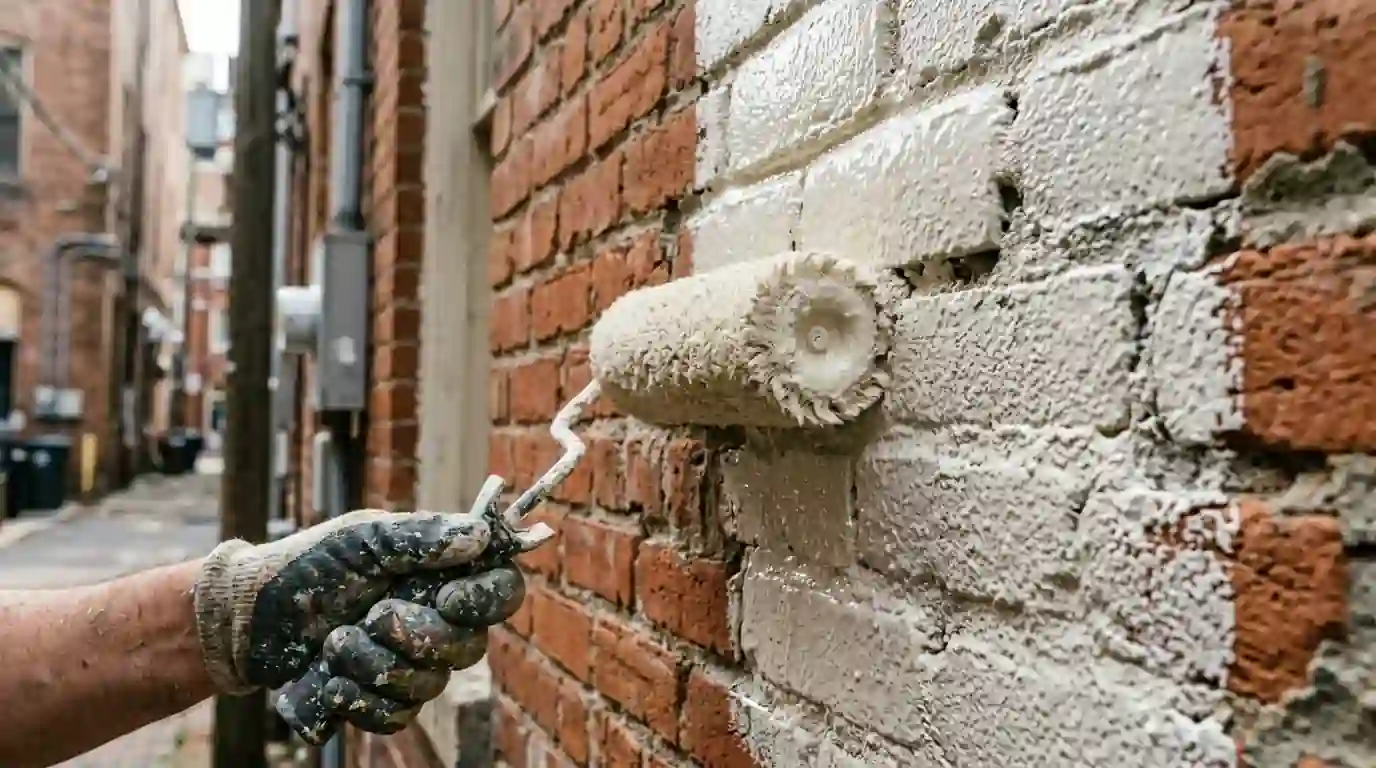
We back-roll or brush each coat into the mortar joints with a thick-nap roller, letting the first cure before the second. Coverage on rough brick is much lower than on siding, so we plan material carefully and keep each coat thin enough to stay breathable. In humid weeks we give the first coat a full day before the second.
When a brick wall is asking for attention
These signs show up on DC rowhouse fronts, side walls and chimneys after a few freeze-thaw winters.
Bubbles and blisters
Paint puffing out from brick means moisture is pushing behind it. Usually the coating was too impermeable, or water is entering from a gutter, cap or cracked joint above.
White powder streaks
Efflorescence is salt carried out of the brick by moving water. It pushes paint off from behind and has to be cleaned and its source addressed first.
Peeling at the base
The bottom few feet of a wall stay wettest from splashback and ground moisture. Paint fails there first, and those courses need extra drying time before recoating.
Faded, chalky color
Sun-facing walls lose their color and binder over time. If the coating is still firmly attached, washing and one or two new coats can bring it back.
Crumbling mortar joints
Sandy or recessed mortar lets water into the wall. Painting over it doesn't stop the water, so repointing comes before paint.
Painted brick in DC: the historic district and old-brick questions
Much of the brick in Washington is soft, handmade or early machine-made brick from the 1800s and early 1900s, laid in lime mortar. It soaks up water and then dries outward through its face. When it's sealed under a dense film, water collects behind the paint, freezes in winter and pops off the brick surface. That's the main reason we use vapor-permeable masonry coatings rather than ordinary house paint.
The other question is permission. In DC historic districts like Capitol Hill, Bloomingdale and Georgetown, painting brick that has never been painted generally needs review by the DC Historic Preservation Office, and Georgetown exterior changes go to the Old Georgetown Board. Repainting brick that's already painted is generally not reviewed. Check with the preservation office before planning work on unpainted masonry, and see our post on painting brick on a DC rowhouse for the questions to ask.
Across the river, Alexandria has its own Board of Architectural Review for the Old and Historic District, so the same caution applies there. If a full paint film isn't a good fit for your brick, limewash or mineral paint may be a better answer.
Brick painting costs in Washington, DC
Masonry pricing is mostly about square footage and how much the old coating fights back.
| Job | Typical range | What moves the price |
|---|---|---|
| Repaint already-painted brick, per sq ft | $2.70 to $5.40 | Height, amount of loose paint, trim and window count |
| Two-story rowhouse front facade | $2,480 to $5,960 | Cornice, bay, railings, sidewalk staging |
| Brick side wall or chimney | $1,370 to $3,840 | Access over roofs or neighbors, ladder versus lift |
| Interior exposed brick wall | $685 to $1,940 | Sealing versus painting, mortar dust, protecting floors |
| Basement masonry walls, per sq ft | $1.80 to $3.90 | Efflorescence, dampness, waterproofing coating choice |
| Pre-wash and coating removal | $340 to $1,280 | Number of layers, failed elastomeric, lead containment |
Typical DC figures only, not a quote; we price your wall after a walkthrough.
Coatings we use on brick, and why
The coating has to let water vapor out while keeping rain from soaking in.
- Breathable acrylic masonry paint, like Sherwin-Williams Loxon, for brick that's already painted and in fair condition.
- Mineral silicate paints, such as Romabio Masonry Flat, that bond into the brick rather than sitting on top.
- A masonry conditioner on chalky or dusty surfaces so the topcoat grips.
- Rust-Oleum direct-to-metal primer on steel lintels and anchor plates before painting over them.
- Thick-nap Wooster rollers and stiff brushes to work coating into mortar joints and brick texture.
- Sealant rated for masonry at window and door perimeters, so the joint between brick and wood trim stops letting water in.
We stay away from dense elastomerics on old soft brick, even though they look tough on the label. The extra stretch isn't worth the trapped moisture on a wall built to breathe.
Where we do this work most often
We take this job across the District and close-in Maryland and Virginia. These are the neighborhoods and cities we cover most, with a ZIP for each.
Questions we hear about this
Is it a bad idea to paint brick on an old DC rowhouse?
Painting bare brick is a one-way decision and generally needs historic review in DC districts, so think it through first. If the brick is already painted, keeping it painted with a breathable coating is often the right call. Taking paint off later is expensive and can damage the brick face.
How often does painted brick need repainting in DC?
With a breathable masonry coating and good mortar, painted brick usually holds 8 to 12 years on sheltered walls and less on south and west faces. Gutters, sill flashing and splashback have a big effect. Our post on how long exterior paint lasts breaks it down by surface.
Can you remove old paint from brick instead of repainting it?
Sometimes. Chemical strippers and careful low-pressure rinsing can take off some coatings, but results on soft old brick are unpredictable and it costs far more than repainting. We usually suggest a test patch on a hidden area first. Call (771) 247-4038 if you'd like us to look at your wall.
What's the difference between painting brick and limewashing it?
Paint forms a film over the brick, while limewash soaks in and bonds with it, wearing away slowly instead of peeling. Limewash is softer looking and very breathable but needs bare or previously limewashed brick. Paint gives a uniform color and is the norm on brick that's already painted.
Do you paint interior exposed brick in DC homes?
Yes. Interior brick from old fireplaces and party walls can be sealed to stop dust or painted in a matte masonry finish. We protect floors carefully, since mortar dust gets everywhere. It pairs well with interior house painting on the same visit.