Short answer
Ceiling painting covers protecting the room, repairing cracks and sags, sealing water or smoke stains with a stain-blocking primer, then rolling two coats of flat ceiling paint wet edge to wet edge. In DC a single room usually costs $240 to $520, with tall stairwells, heavy stains and loose plaster pushing a job toward the top of that range.
Ceiling prices across a typical DC house
Ceilings are priced per room or per area. Height and the condition of the surface matter more than the room's footprint.
| Job | Typical range | What moves the price |
|---|---|---|
| Bedroom or office ceiling, two coats | $240 to $395 | Fixture count, closet ceilings and cracks to fill |
| Living or dining room ceiling, 9 to 11 ft | $335 to $520 | Plank or scaffold setup and the size of the open area |
| Stairwell ceiling over a landing | $410 to $780 | Ladder staging over stairs and the drop to the lower floor |
| Stain blocking on a leak mark | $95 to $210 | How many layers of shellac primer the stain needs before it stops bleeding |
| Plaster crack and patch area | $185 to $640 | Loose plaster that needs re-anchoring rather than filling |
| Popcorn removal before paint, per sq ft | $2.10 to $4.60 | Asbestos test results and skim coat needed after scraping |
These are typical ranges, not a quote; we look up close at your ceilings before setting a price.
Ceiling trouble we fix most often
Ceilings get ignored until something shows up on them. These are the marks that bring DC homeowners to us.
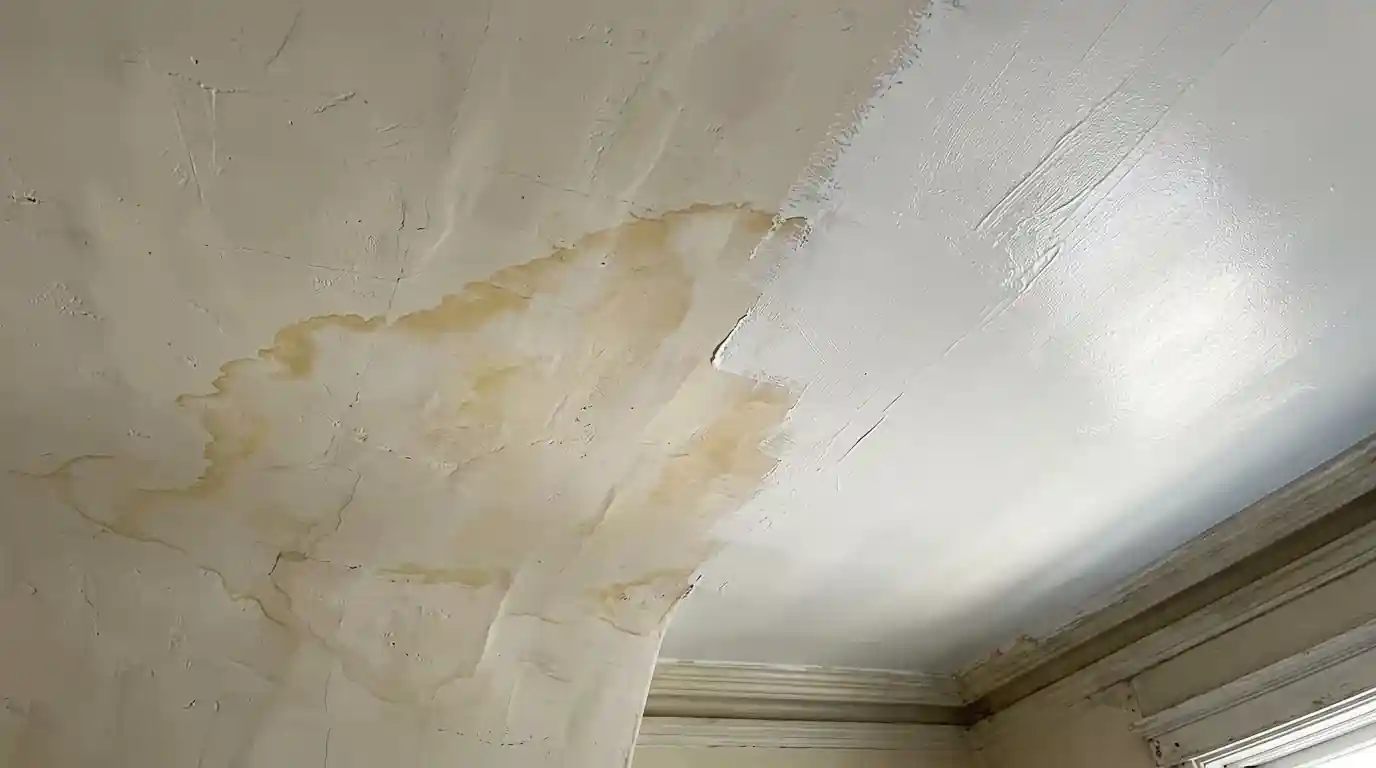
Rings from old leaks
Radiator valve drips, bathtub overflows and flat-roof leaks leave tan or brown rings. Once the leak is fixed and the plaster is dry, the stain still bleeds through plain latex. It needs a sealing primer first.
Cracks around fixtures
Ceiling plaster cracks in a star around light boxes and along lath lines in the middle of the room. Fine cracks get taped and filled, while wide or sagging ones need plaster repair before paint.
Smoke and cooking film
Kitchen ceilings collect a greasy haze, and older homes with fireplaces or past smokers have yellow ceilings throughout. We wash and prime with a product that locks in both the stain and the odor.
Mildew spots in baths
Small black spots over the shower mean steam is lingering. We kill the mildew, let it dry and finish with a moisture-resistant ceiling paint. A working exhaust fan keeps it from coming back.
Patchy, uneven sheen
Ceilings painted with wall paint in eggshell or touched up over the years show shiny spots and roller laps in raking light. A true flat ceiling paint hides those and evens out the whole surface.
What makes ceilings tricky in older DC houses
Many DC homes, especially rowhouses in Petworth and Capitol Hill, have plaster ceilings that are a century old. Over time the plaster keys that hold it to the wood lath break, and the ceiling starts to sag or crack in long lines. A fresh coat of paint adds weight and moisture, so we press-test any suspect area and re-anchor it with plaster washers before painting. That small step prevents a much larger repair later.
Ceiling heights also vary a lot. Main floors in older rowhouses often run 10 or 11 feet, and Victorian homes on Capitol Hill can reach 12. That means planks, extension poles and careful staging over furniture. In stairwells we build a stable plank deck over the steps instead of balancing a ladder on a tread, which takes longer to set up but makes the work safe and the finish even.
Top-floor ceilings under DC's flat rowhouse roofs are where most leak stains show up. If you've had roof work done, let the plaster dry out fully before we paint. A ceiling that still feels cool or damp will push the stain through even good primer. If you're unsure, we'll check it with a moisture meter at the walkthrough.
Our order of work on a ceiling
Ceilings get painted before walls, so drips and roller spatter land on surfaces that are still to be painted.
- Coat 01
Clear and cover
We push furniture to the walls or out of the room and cover everything with plastic. Floors get canvas drops edge to edge, because ceiling work drips more than walls do. Light fixtures are wrapped or dropped down with the power off.
- Coat 02
Check the plaster
We press gently across the ceiling and tap with a knuckle. Spots that move or sound hollow get re-anchored with plaster washers and screws, and cracks get mesh tape and setting compound.
- Coat 03
Seal stains
Water and smoke stains get a shellac primer such as Zinsser BIN, applied a little past the edge of the mark. Heavy stains may need two coats. Patched areas get primer so they don't flash.
- Coat 04
Cut along the walls
We cut the ceiling line with an angled brush from a ladder, working in short sections so the edge stays wet when the roller arrives. If walls are being painted too, we let the ceiling color wrap a hair onto them.
- Coat 05
Roll in one direction
We roll with a 1/2-inch nap cover on an extension pole, working across the shortest dimension of the room and keeping a wet edge. The final pass on each section goes in the same direction, away from the main window, to hide laps.
- Coat 06
Second coat and inspection
After two to four hours we apply the second coat. Once dry, we check it with a work light held flat to the surface, fix any thin spots, and put fixtures and furniture back.
Paints and primers we put overhead
Ceilings need different paint than walls. Here's what we reach for and why.
- Benjamin Moore Ultra Spec 500 flat or Sherwin-Williams ceiling paint, slow-drying flats that hide laps on wide ceilings.
- Zinsser BIN shellac primer for water rings, smoke and nicotine, since it blocks bleed in one or two coats.
- A mildew-resistant flat or matte for bathrooms and laundry rooms where steam lingers.
- Setting-type joint compound for crack repair, because it hardens quickly and resists shrinking on plaster.
- Wooster and Purdy roller covers in 1/2-inch nap to load enough paint for a single smooth pass.
- Ceiling white by default, though a tinted ceiling one shade lighter than the walls can make a room feel taller.
What to expect when we paint your ceilings
Ceiling days are a little more disruptive than wall days, so here's how they usually run.
- We ask that rooms be emptied of anything fragile, since ladders and planks move around a lot overhead.
- Smoke detectors are covered during painting and uncovered before we leave each day.
- Expect most rooms to be done in one day, with stain blocking adding an extra half day when two primer coats are needed.
- We'll need power off briefly to lower any fixture we paint around.
- If you have a popcorn ceiling you'd like gone, it's best removed before we paint anything else.
Have a leak stain you want looked at? Call us at (771) 247-4038 any hour and we'll set up a time to see it.
Where we do this work most often
We take this job across the District and close-in Maryland and Virginia. These are the neighborhoods and cities we cover most, with a ZIP for each.
Questions we hear about this
Why does the water stain on my DC ceiling come back after painting?
Water carries minerals and tannins from wood lath into plaster. Plain latex paint lets those compounds bleed through again within days. The fix is a stain-blocking primer, usually shellac based, applied past the stain's edge and allowed to dry before finish coats. It also has to be dry behind the stain, so we check with a moisture meter after any recent roof or plumbing repair.
Can you paint a sagging plaster ceiling in an old rowhouse?
Only after it's secured. Sagging plaster has lost its grip on the lath, and paint adds weight and moisture. We re-anchor it with plaster washers and screws, fill and skim the area, then prime and paint. If a large section is badly detached, we'll recommend a fuller repair before painting. More detail is in our guide on plaster versus drywall repair.
Should ceiling paint be flat or can I use eggshell in a DC kitchen?
Flat is best for most ceilings because it hides imperfections and roller marks. In kitchens and baths, a washable matte or a moisture-resistant flat gives some cleanability without the shine that shows every flaw. We rarely suggest eggshell on ceilings in older plaster homes, since raking light from windows makes any sheen show the bumps.
Do you need to move my furniture out of the room to paint the ceiling?
Not always. In bedrooms we can usually stack furniture in the center and work around it. For high ceilings or large rooms we may need the floor clear to set up planks, and we'll move pieces into the next room with you. Pianos, aquariums and anything very heavy should stay put, and we work around those with extra coverage.
Is it worth painting ceilings when we only repaint the walls?
In most older DC homes, yes. Ceilings yellow over time and look dingy next to fresh walls. Doing both in one visit costs less than two separate jobs, and we paint ceilings first so drips land on walls about to be painted. It fits naturally into a full interior repaint.