Short answer
On Capitol Hill we mostly repair and paint plaster interiors and repaint rowhouse fronts: cornices, window trim, doors, stoops and iron railings. We check plaster, test old finishes, plan lead-safe steps and talk through historic district rules. Facades usually take three to six working days; a plaster-heavy interior floor about one to two weeks.
Victorian and Federal rowhouses from Eastern Market to Lincoln Park
Capitol Hill stretches east from the Capitol and the Library of Congress toward Lincoln Park and beyond, with Pennsylvania Avenue SE and East Capitol Street running through its center. Eastern Market, the brick market hall on 7th Street SE, has been a neighborhood anchor since the 1870s, and Barracks Row along 8th Street SE has its own long history beside the Marine Barracks.
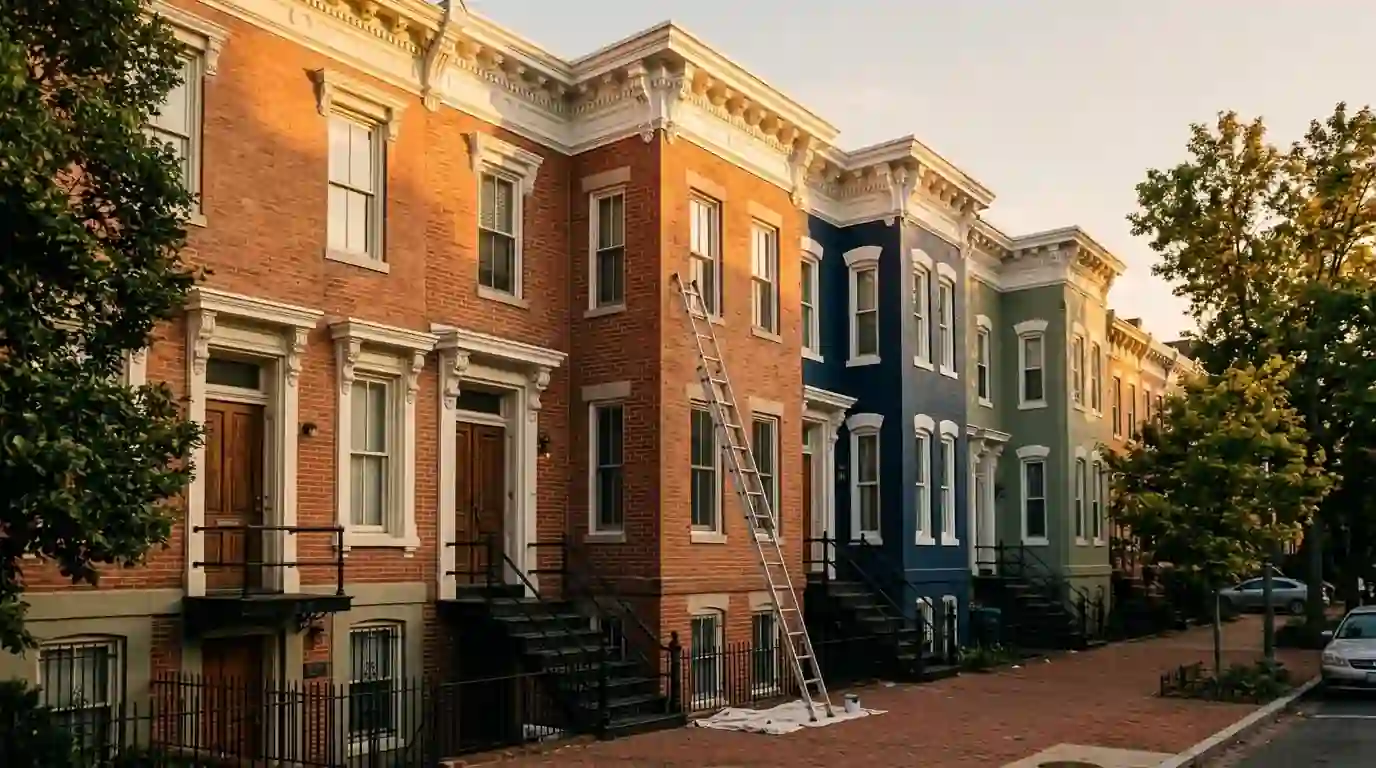
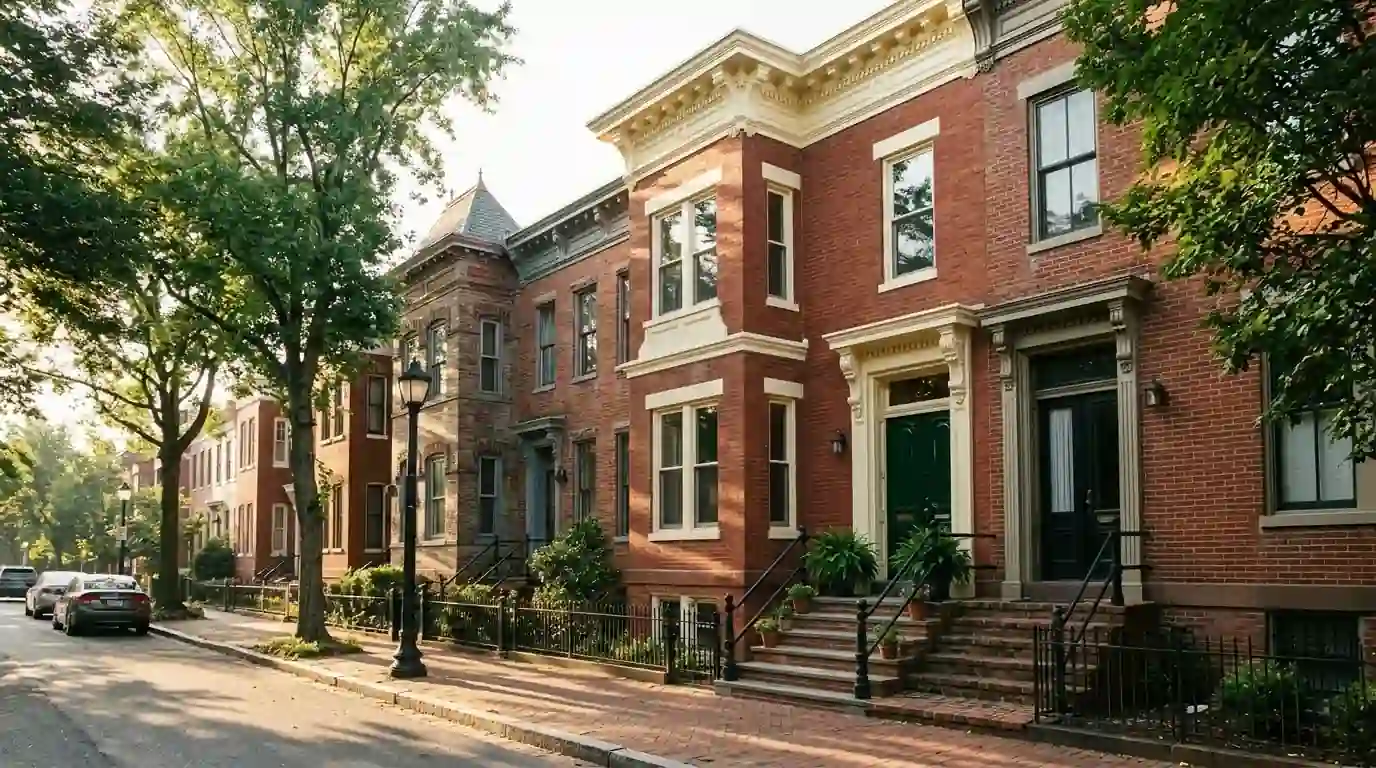
Most houses here are rowhouses built from the 1850s to the early 1900s. The oldest are Federal-style flat-front brick houses, while later blocks have Italianate and Queen Anne fronts with projecting bays, turrets, pressed-metal or wood cornices, decorative brick and iron stoops. Many sit above English basements, often rented as separate units. Inside, you'll find plaster on wood lath, tall ceilings with plaster medallions, deep window casings and narrow stairways along party walls.
These houses are sturdy, but time, heat and moisture take a toll. Plaster cracks at stair halls and ceilings, cornices lose paint and rot at the joints, and iron railings rust at their bases. That's why so much of our work here is plaster repair and rowhouse exterior painting.
Historic district rules, parking and access on Capitol Hill
The Capitol Hill Historic District and tight streets shape how we schedule work.
- Most of the neighborhood sits in the Capitol Hill Historic District, where painting previously unpainted brick or masonry generally needs review, so check with the DC Historic Preservation Office first.
- Repainting already-painted wood trim, doors or cornices in a new color is generally not reviewed, but it's worth confirming before you choose a strong color change.
- Residential permit parking covers nearly every block, so we generally request DDOT emergency no-parking signs for facade work.
- Many blocks have rear alleys, which make it easier to bring in ladders and materials for rear walls.
- English basement tenants need notice about access, noise and paint fumes, which we plan with you before starting.
- We answer the phone 24/7, and we paint during normal weekday hours to keep neighbors on shared walls comfortable.
Plaster and facade problems common in Capitol Hill rowhouses
These conditions come up on most Capitol Hill walkthroughs.
Stair hall cracks
Stair walls along party walls crack from settling and from years of furniture moving. We tape with mesh and setting compound and skim so the cracks stay hidden longer.
Sagging ceiling plaster
Ceilings in front parlors sag where the plaster keys have broken. We re-anchor with plaster washers and adhesive before skimming and painting.
Cornice rot and peel
Wood and pressed-metal cornices lose paint at joints and seams. We scrape, repair rot, treat rust and prime before painting with an exterior enamel.
Rusty stoop railings
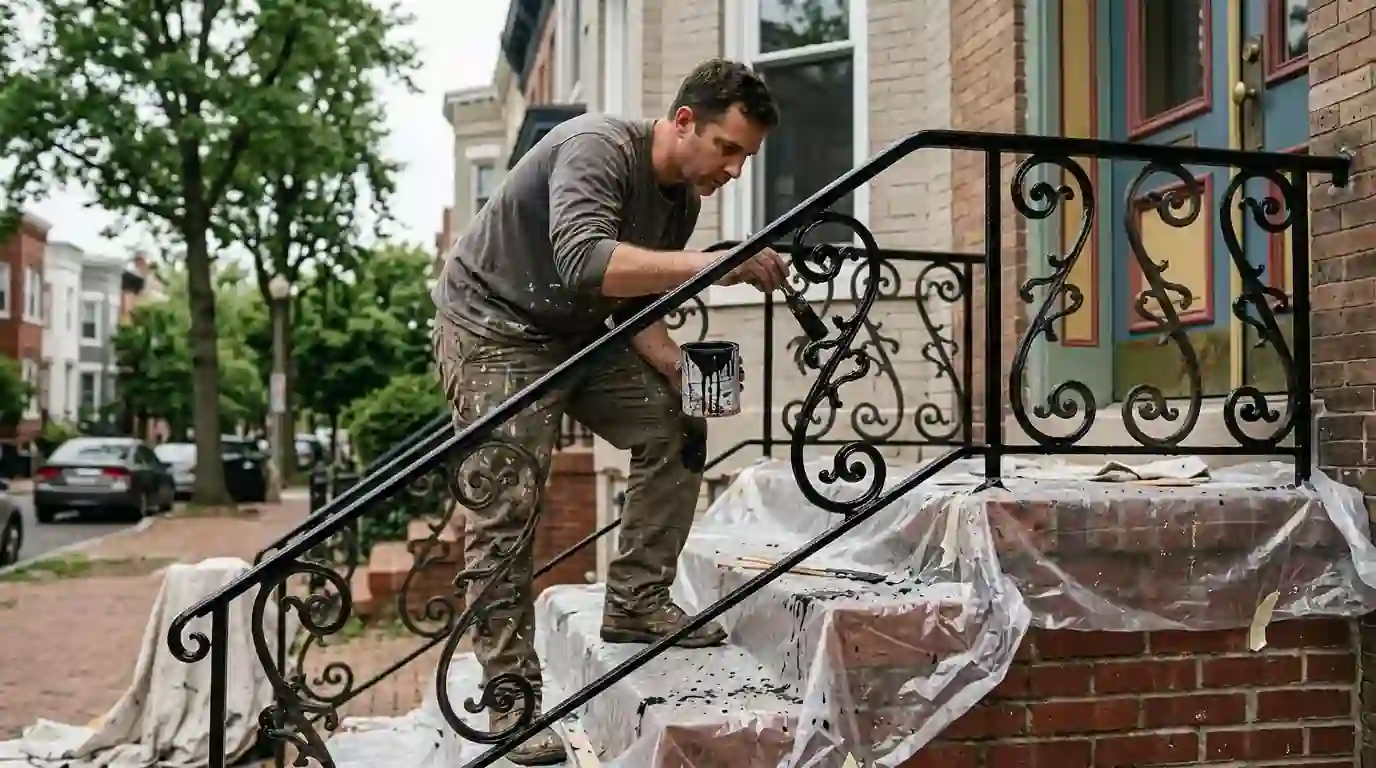
Iron railings rust at post bases and welds. We grind rust, prime with a rust-inhibiting primer and coat with a durable metal enamel.
Damp English basements
Below-grade walls take on moisture, causing paint to blister and peel. We clean, use masonry primers and moisture-tolerant paint suited to the space.
Many layers of trim paint
Window casings and doors with many paint layers lose detail. We sand or strip back where needed so profiles stay crisp.
How we repaint a Capitol Hill rowhouse front from cornice to stoop
Here's a typical facade job on a painted-trim brick rowhouse.
- Coat 01
Walk and plan
We look at cornice, windows, door and railings and talk about color. Typical rowhouse front facades run $2,350 to $6,900, depending on height, cornice condition and railing length.
- Coat 02
Signs and setup
We post DDOT emergency no-parking signs, set ladders or scaffolding and lay plastic on the sidewalk and stoop for lead-safe work.
- Coat 03
Scrape and repair
Loose paint is wet-scraped, rot repaired and joints recaulked. Pressed-metal cornices are wire-brushed and spot-primed with a rust-inhibiting primer.
- Coat 04
Prime and paint
Bare wood gets primer, then two coats of exterior paint go on the cornice, window trim and door. We cut cleanly along brick so lines look sharp from the sidewalk.
- Coat 05
Railings last
Iron railings are ground, primed and enameled last so the stoop isn't blocked for long. Typical pricing is $14 to $38 per linear foot.
- Coat 06
Clean and review
We HEPA clean, remove signs and plastic and walk the front with you, touching up anything you notice.
Most requested here
Rowhouse Exterior Painting
Front facades, cornices, bays and porch fronts painted with shared party-wall edges and sidewalk access in mind.
Plaster Repair
Cracked and sagging plaster re-anchored and skim coated so pre-war walls stay plaster, not drywall.
Historic Home Painting
Pre-war plaster, old-growth wood trim and original windows painted with methods that respect the house.
Iron Railing & Fence Painting
Rust ground off, converted and primed before stoop railings and iron fences get a durable enamel coat.
Lead-Safe Painting
Containment, wet scraping and HEPA cleanup when older paint is disturbed in homes built before 1978.
Basement Painting
Masonry walls, floors and English basement units painted with coatings made for damp, below-grade rooms.
Interior House Painting
Walls, ceilings and trim in occupied homes, with furniture moved, floors covered and rooms back in use each night.
Window Sash & Trim Painting
Glazing checked, sashes and frames painted, and windows left operable instead of painted shut.
Close by
ZIP codes we cover here: 20003, 20002. We also paint in these neighboring areas.
Questions from Capitol Hill homeowners
Do I need approval to paint the brick on my Capitol Hill rowhouse?
If the brick has never been painted, it generally needs review because the house sits in the Capitol Hill Historic District, so check with the DC Historic Preservation Office first. If it's already painted, repainting is generally simpler. Our brick painting work uses breathable masonry coatings either way.
How much does plaster repair cost in a Capitol Hill rowhouse?
Smaller crack and patch areas usually run $185 to $640, while skim coating a full room typically runs $1,150 to $2,800. Stair halls and parlor ceilings often need more. We price after tapping and mapping the plaster on the walkthrough.
Can you paint my Capitol Hill English basement unit?
Yes. We use primers and paints suited to damp below-grade walls and plan around tenant access. Typical masonry wall painting runs $1.80 to $3.90 per square foot. Call (771) 247-4038 to book a walkthrough.