Short answer
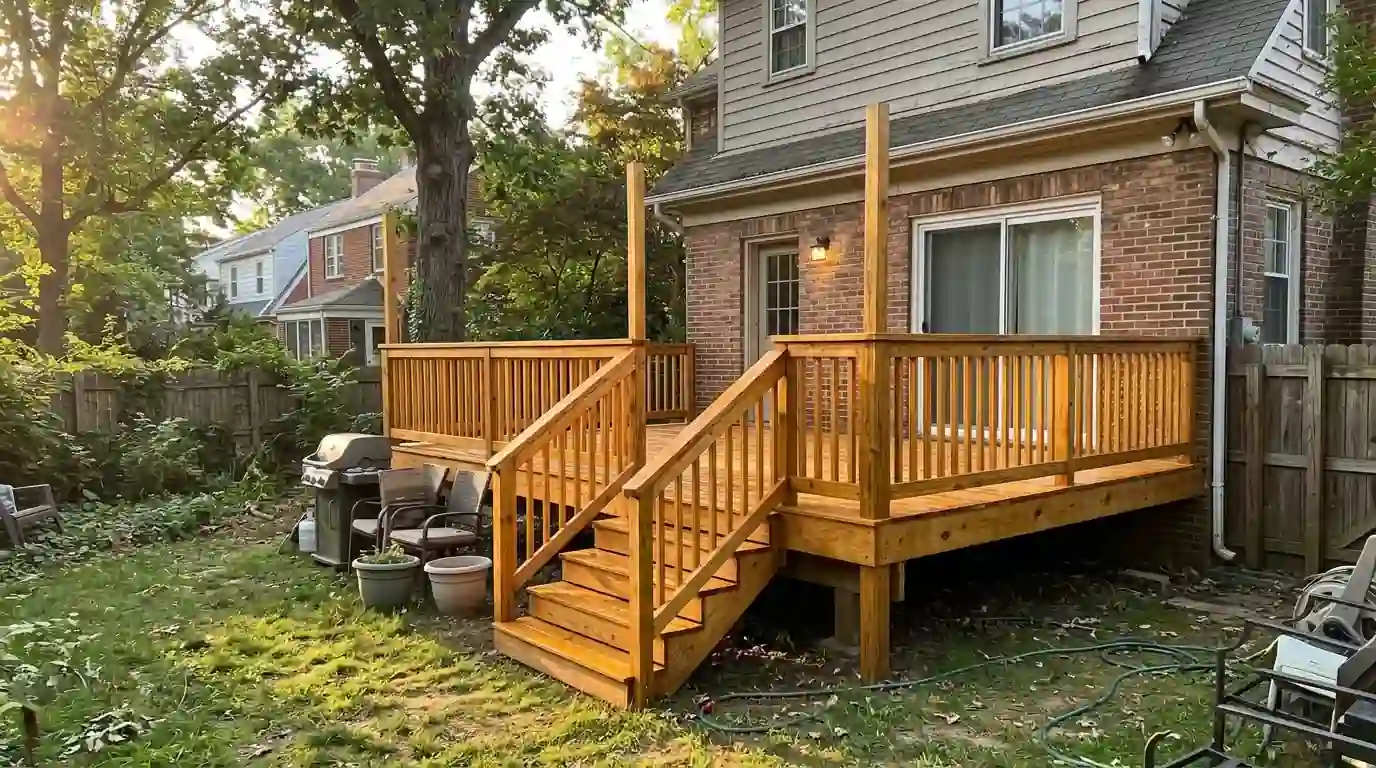
Deck staining in DC involves cleaning or stripping old finish, brightening the wood, sanding rough spots, letting boards dry for two or three days and applying one or two coats of stain. Typical cost is $1.90 to $4.30 per sq ft. Stairs, railings and heavy stripping push the price up, and new pressure-treated decks usually wait a season first.
How deck staining is priced around the District
Square footage sets the base. Railings, steps and the condition of the old finish move it from there.
| Deck job | Typical range | What moves the price |
|---|---|---|
| Wash, brighten and one coat of penetrating stain | $1.90 to $2.85 per sq ft | Board condition, how much gray fiber has to come off and whether the old stain is already gone |
| Strip old film, brighten and two coats | $2.95 to $4.30 per sq ft | Number of old coats, peeling solid stain, and how much sanding the flat boards need afterward |
| Railings and balusters | $7.40 to $15.80 per linear ft | Baluster count, square versus turned spindles and how much hand brushing the rails need |
| Stairs | $85 to $165 per step | Tread width, stringers, risers, and whether the stair is stained or painted |
| Board replacement before staining | $240 to $1,150 per area | Number of soft boards, joist condition underneath, and matching lumber to older decking |
| Small rowhouse back deck | $745 to $1,690 | Access through the house or alley, a second-story deck, and how close neighbors' yards sit |
These are typical ranges, not a quote; we price your deck after walking it and checking the boards.
Penetrating or solid stain: which suits your deck?
The age and condition of the wood matter more than color when picking a stain type.
Clear and toner finishes
Show the full grain and add UV protection with a light tint. They look great on new cedar or well-kept boards but need a fresh coat every year or so in DC sun.
Semi-transparent penetrating stain
Soaks into the wood rather than forming a film, so it fades instead of peeling. Recoats are quick, usually every two to three years, and it's our usual pick for decks in good shape.
Semi-solid stain
More pigment hides mismatched boards and minor weathering while still showing some grain. A useful middle ground on decks that have a few replacement boards.
Solid stain
Covers like paint and hides old, checked or patched wood. It lasts longer on vertical rails but can peel on flat boards, so we use it carefully on walking surfaces.
Resurfacing coatings
Thick roll-on products sold for worn decks. They tend to trap water and peel badly in freeze-thaw winters, so we usually steer you toward board replacement instead.
What happens on staining days
Most decks take three to five days start to finish, with drying time between steps doing much of the work.
- Coat 01
Board-by-board inspection
We probe board ends, stair stringers and posts with an awl, and set screws on loose boards. Soft wood gets marked for replacement, and we check ledger flashing where the deck meets the house.
- Coat 02
Strip or wash
Old film stain comes off with a stripper and a low-pressure rinse around 500 to 800 PSI. Decks without film get an oxygen-based cleaner to lift dirt and mildew instead.
- Coat 03
Brighten the wood
An oxalic acid brightener neutralizes the stripper, removes tannin stains and restores color. Skip this and the stain often looks blotchy or dark gray on older boards.
- Coat 04
Dry two or three days
Boards need to read under about 15 percent moisture. In humid DC weeks that can take a little longer, and we won't stain on a day with afternoon thunderstorms in the forecast.
- Coat 05
Sand raised fibers
Washing lifts fuzz on the boards. We sand the flat surfaces and rail caps with 60 to 80 grit so stain soaks in evenly and the surface feels right under bare feet.
- Coat 06
Stain with brush, pad and back-brush
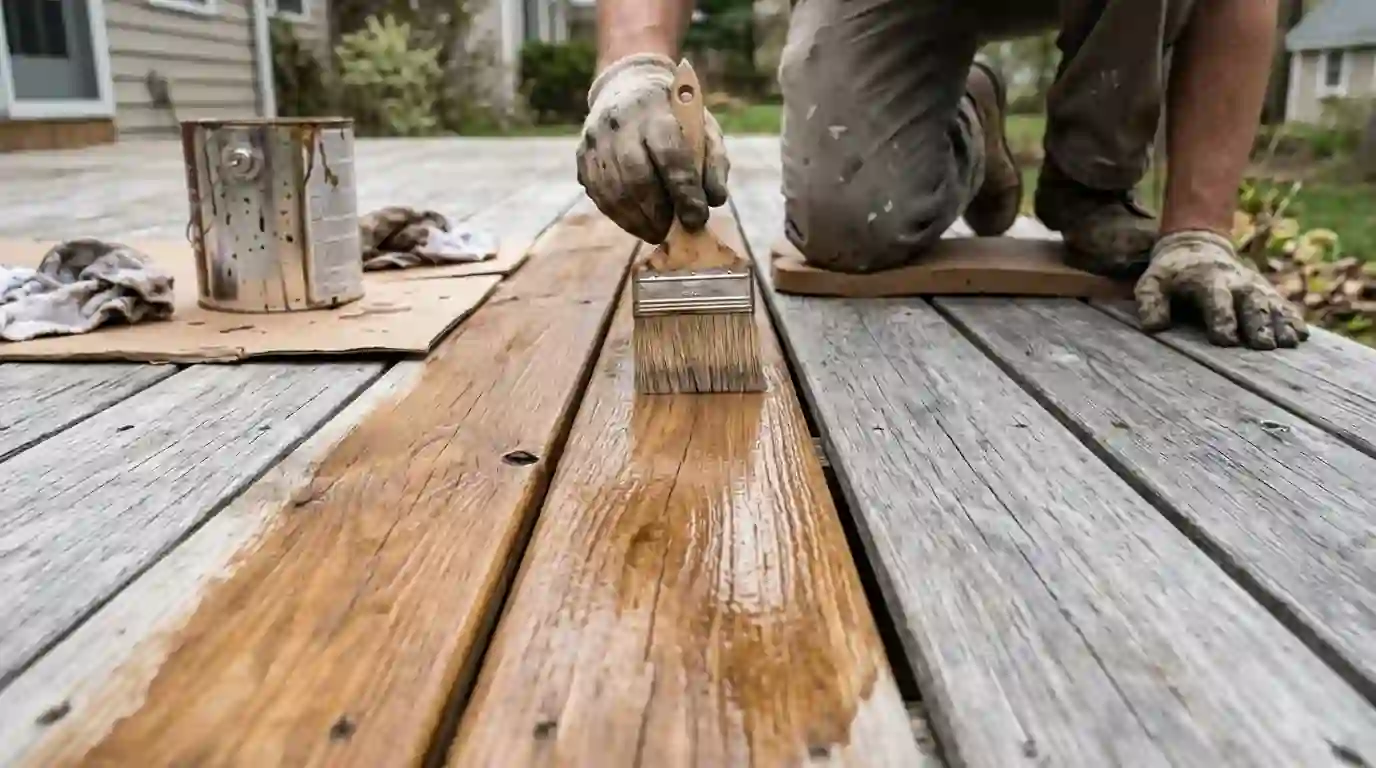
We apply stain two or three boards at a time along their full length to avoid lap marks, back-brushing it into the grain. Penetrating stains are wiped of excess after about 20 minutes.
- Coat 07
Cure and light-traffic window
Bare feet are usually fine after 24 hours, furniture after 48 to 72. Grills and planters go back last so they don't leave rings on a soft finish.
DC weather is hard on decks: what that means for your stain
July sun and humidity break down stain fastest on the flat boards, while winters that cycle above and below freezing open every check in the wood. Water gets in, freezes and widens the crack. That's why flat decking almost always needs a recoat before vertical rails do, and why penetrating stain often outlasts solid stain on walking surfaces here.
Timing matters too. The best windows are usually late spring and early fall, when nights stay above 50 F and humidity drops. Midsummer staining is possible, but we work early to keep stain out of direct afternoon sun, which flashes it dry before it soaks in. Detached homes in Woodridge and out in Fairfax County tend to have big, full-sun decks that need this most.
New pressure-treated lumber is its own case. It's often wet from the treatment plant, so we usually wait a few months to a full season before the first coat. Staining too soon is a common reason a new deck peels in its first year.
Stains we trust on DC decks
We pick products by the wood and the look you want, not by one favorite brand.
- Penetrating oil stains from Cabot or Sikkens for cedar and older pressure-treated decks where you want the grain to show.
- Water-based semi-transparent stains from Sherwin-Williams or Benjamin Moore for faster dry times and easier cleanup, useful on tight alley-access jobs.
- Solid deck stains for railings, posts and skirt boards that are mismatched or heavily weathered.
- Oxalic acid brighteners after every strip or wash, even on decks that look fairly clean.
- Wide stain pads and Purdy brushes for decking and rails, with a pump sprayer only where we can fully control overspray.
- Exterior wood filler and replacement boards cut to match for the soft spots found at inspection.
Getting the deck ready for us
Most of this takes an evening and saves a few hours on the first day.
- Move furniture, grills, planters and rugs off the deck and away from the stairs.
- Sweep off leaves and pine needles, especially from the gaps between boards.
- Turn off sprinklers aimed at the deck for two days before and after staining.
- Tell us about any boards that feel soft or bounce so we check them first.
- Plan to keep kids and pets off the deck until the stain is dry to the touch.
Where we do this work most often
We take this job across the District and close-in Maryland and Virginia. These are the neighborhoods and cities we cover most, with a ZIP for each.
Questions we hear about this
How often does a deck in DC need restaining?
Penetrating semi-transparent stain on flat boards usually needs a fresh coat every two to three years here, rails a bit less often. Solid stain lasts longer on vertical surfaces but can peel on decking. Sprinkle water on the boards: if it soaks in fast, it's time to recoat.
Can you stain a deck on the second floor of a rowhouse?
Yes. Many Capitol Hill and Petworth rowhouses have small upper decks over a kitchen addition. We bring materials through the house or alley, tarp the yard below and keep runoff out of the neighbor's space. It takes more setup, which is reflected in the price.
Should the railings be painted or stained to match the house?
Either works. Painted railings with stained decking is a popular look, since paint lasts longer on vertical pieces. If the rail ties into fence staining or house trim, we'll match the color to that. A color consultation can help if you're unsure.
Do you stain composite decks?
Composite isn't stained the way wood is. We can clean composite boards and paint or stain any wood rails, posts and stairs that are attached to it. Some older composite can take a specialty coating, but we'll check the manufacturer's guidance first.
What if some deck boards are rotten?
We mark soft boards during the inspection and price their replacement before staining starts. Staining over rot only hides it for a few months. If the joists or ledger are damaged, we'll tell you and point you to a carpenter for the structural part. Call (771) 247-4038 to set up a walkthrough.