Short answer
Porch painting in DC covers scraping and sanding the floor, fixing soft boards, priming bare wood, and two coats of porch and floor enamel, plus columns, rails and the ceiling. Floors typically cost $2.40 to $4.80 per sq ft. Older porches often need lead-safe prep, and the floor stays off-limits to foot traffic for a day or two.
Wear patterns that mean your porch needs paint
Porches fail from the top step inward. These are the spots we check first on a walkthrough.
Bare paths at the door
A worn track from the steps to the front door means the floor enamel is gone in the busiest area. Bare tongue-and-groove boards then drink in rain and start to cup.
Peeling at board ends
End grain soaks up water fastest. Paint curling at the edge of the porch or along the top step usually signals that moisture is getting under the film.
Mildew on the ceiling
Porch ceilings stay shaded and humid, so dark spotting shows up there before anywhere else. Washing and a mildew-resistant finish clear it.
Cracked column bases
Wood columns wick water up from the floor. Open cracks at the base let rot start inside, which is easy to miss until the column feels soft.
Rusty or flaking railings
Wood rails split at the joints and iron railings rust at the base posts. Both look worse each winter after salt and freeze-thaw cycles.
What porch painting usually runs in DC
Porch work is a mix of flat floor area and lots of small, detailed pieces, so we price the parts separately.
| Porch area | Typical range | What moves the price |
|---|---|---|
| Porch floor, prep and two coats | $2.40 to $4.80 per sq ft | Peeling paint to remove, soft boards, sanding needs and lead-safe containment on older floors |
| Porch steps and stringers | $70 to $155 per step | Tread width, side stringers, nonslip additive and whether the steps are wood or concrete |
| Beadboard or tongue-and-groove ceiling | $1.85 to $3.60 per sq ft | Mildew washing, staining from old roof leaks and color change, including haint blue |
| Columns | $145 to $385 each | Round versus square, height, cracks to fill and base or capital detail |
| Wood railings and balusters | $9.80 to $21.50 per linear ft | Baluster count and shape, top rail condition and peeling between spindles |
| Typical rowhouse front porch, all surfaces | $1,385 to $3,940 | Porch size, number of steps, rot repair and lead-safe setup |
These are typical ranges for planning, not a quote; we confirm the price after seeing your porch.
The porch-front rowhouse is a DC original
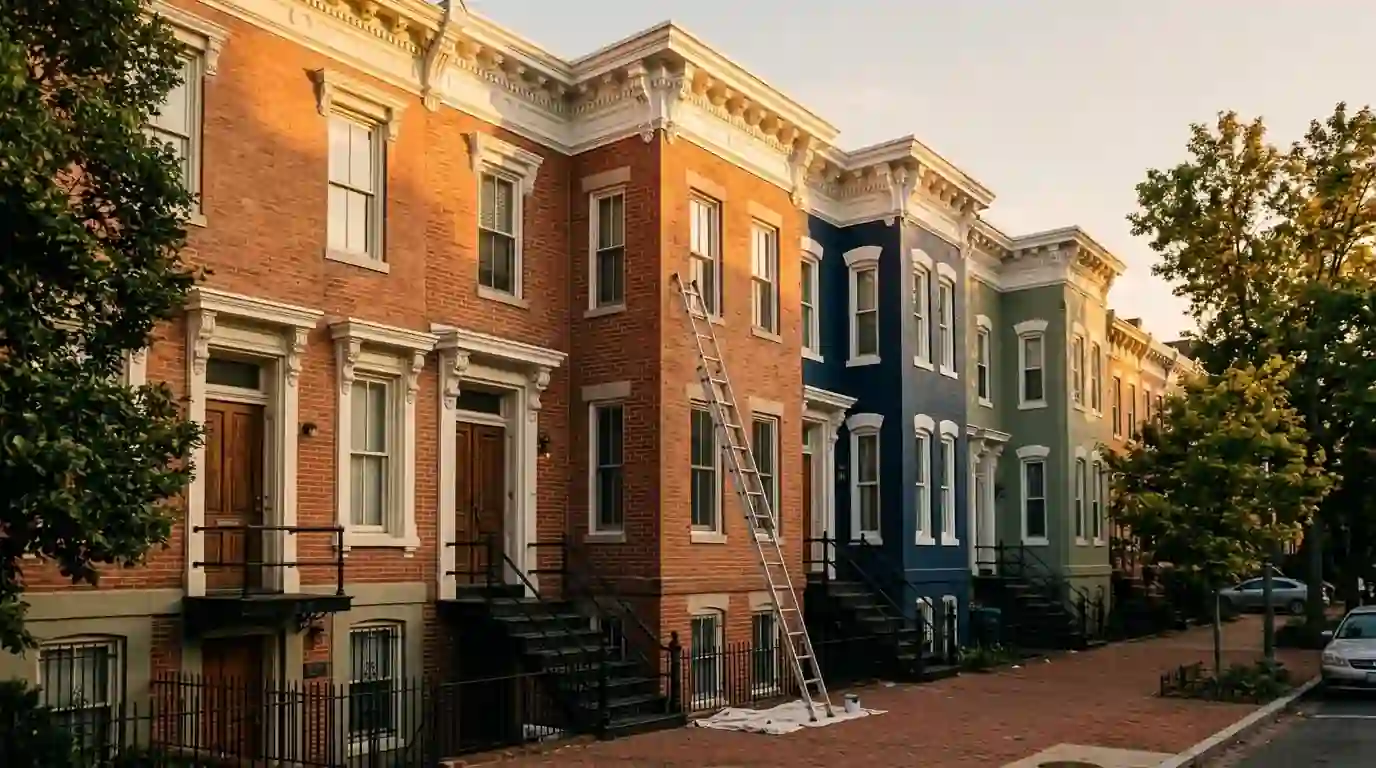
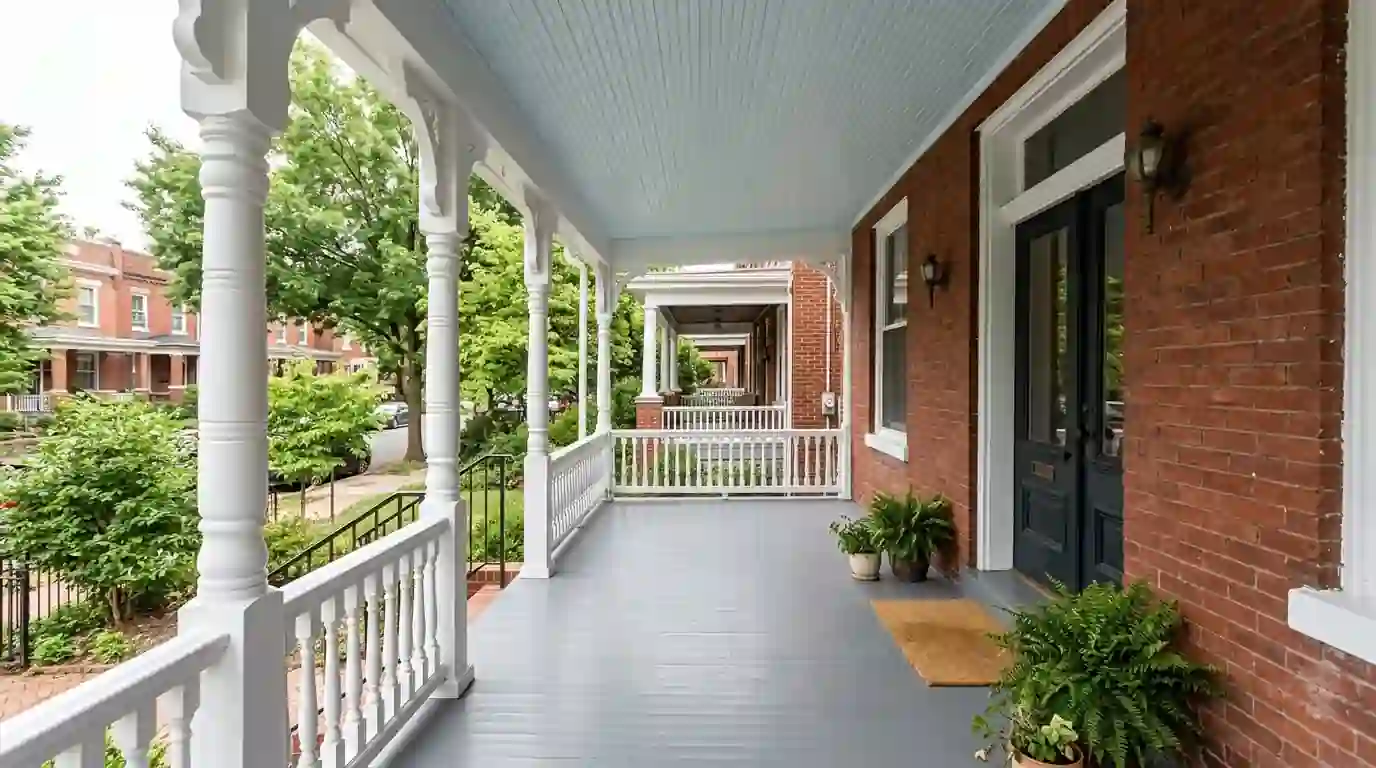
Whole blocks of Brookland, Petworth and Bloomingdale were built in the early 1900s with wide front porches shared down the row, each separated by a low rail or a single post. Those porches have tongue-and-groove fir floors, beadboard ceilings, turned columns and often an iron or wood railing. They were built to be painted, and many have dozens of coats on them already. That history matters, because older layers frequently contain lead, and porches are where kids and pets spend time.
Shared porches also mean shared edges. Your floor paint runs right up to your neighbor's, sometimes with no divider at all. We cut a clean line at the property edge and keep drop cloths and tape on our side. If you and the neighbor want to paint at the same time, we can price both porches so the colors and sheen match.
Weather drives the schedule. Floor enamel needs surface temperatures above 50 F and a dry board, so most porch floors get done between April and October. In summer we start early to keep paint off boards baking in direct afternoon sun.
Our porch painting sequence, floor to ceiling
We paint top down, so drips from the ceiling and columns never land on a finished floor.
- Coat 01
Lead check and setup
On porches built before 1978 we test or assume lead, then lay plastic, close nearby windows and post signs. Scraping is done wet and debris is collected, following EPA RRP lead-safe work practices.
- Coat 02
Wash and scrape the ceiling
The ceiling is cleaned with a mild mildew wash, loose paint is scraped and sanded smooth at the edges, and stains from old roof leaks get a stain-blocking primer.
- Coat 03
Columns, rails and trim
Cracks in columns are filled with exterior filler, joints are caulked and bare wood is primed. Railings are scraped and spot primed before two finish coats.
- Coat 04
Repair floor boards
Soft tongue-and-groove boards are cut out and replaced with matching profile stock. Loose boards are fastened and nail heads are set below the surface.
- Coat 05
Sand and prime the floor
The floor is scraped and sanded to feather peeling edges. Bare wood gets an oil-based or bonding primer, with extra attention to the end grain at the porch edge.
- Coat 06
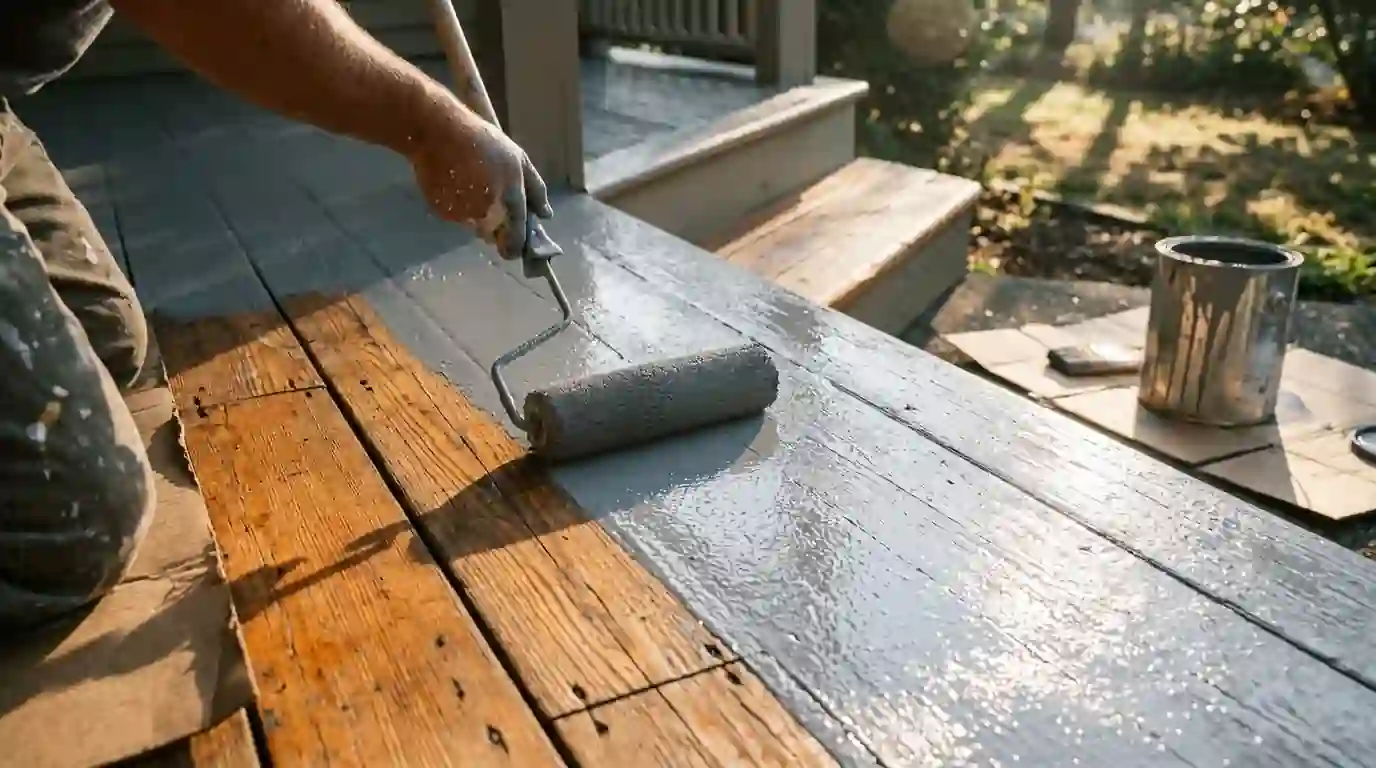
Two coats of floor enamel
We roll porch and floor enamel along the board length, working out from the house to the steps. A fine nonslip additive goes into the steps if you want it.
- Coat 07
Cure and reopen
Light foot traffic is usually fine after 24 hours, furniture after 72. We leave a marked path or plank for the front door if you need to come and go sooner.
Floor enamel, ceiling paint and the haint-blue question
Porch floors need a product rated for foot traffic. We typically use porch and floor enamels from Sherwin-Williams or Benjamin Moore, in satin or low-gloss sheens that hide wear and give some grip. Oil-modified versions cure harder; water-based ones stay more flexible as boards move. On weathered fir we often prime with an oil-based primer from Zinsser first, because it soaks deep into dry end grain.
The ceiling is where homeowners have fun. Haint blue, the pale sky-blue tradition from the South, shows up all over DC porches. Whatever color you choose, we use a mildew-resistant exterior finish in flat or satin. If you can't pick a shade, our color consultation brings samples to see in your own porch light, and many owners pair porch work with a rowhouse exterior repaint of the full facade.
Living with a porch under paint for a few days
Porch work blocks the front door more than any other exterior job, so a little planning helps.
- Use the back or alley door for two or three days if you have one.
- Have packages held or sent to a neighbor while the floor cures.
- Take down hanging plants, wind chimes and the porch swing before we start.
- Move doormats, chairs and planters inside so they don't stick to wet enamel.
- Let mail carriers know about the work if your mailbox hangs by the door.
Where we do this work most often
We take this job across the District and close-in Maryland and Virginia. These are the neighborhoods and cities we cover most, with a ZIP for each.
Questions we hear about this
How long do I have to stay off a freshly painted porch floor?
Plan on 24 hours before walking on it in socks or soft shoes, and 72 hours before furniture, planters or rugs go back. Full hardness takes a couple of weeks, so avoid dragging anything heavy across it. If you need the front door, we'll leave a protected path.
Can you match my neighbor's porch color on a shared rowhouse porch?
Usually, yes. We can take a color sample from the neighbor's floor or railings, with their okay, and have it matched. Sheen is part of the match too, since the same color in satin and gloss looks different. We cut a clean line at your shared edge either way.
Is it safe to sand an old DC porch floor?
Many porch floors from before 1978 have lead in older coats. We don't dry sand them in the open. We test, contain the area, wet scrape and use HEPA vacuums under EPA RRP lead-safe work practices. Our lead-safe painting page explains the setup in more detail.
Can you paint a concrete porch or steps?
Yes. Concrete porches get cleaned, etched and coated with a concrete porch paint or a masonry coating with a nonslip additive. Very worn concrete might suit an epoxy floor coating better if it's covered. Call (771) 247-4038 and we'll look at it.
What should I do about soft or rotten porch boards before painting?
Don't paint over them. We probe the floor at the walkthrough and replace soft tongue-and-groove boards with matching stock. If the joists below are soft too, we'll show you and recommend a carpenter for the framing. Paint only lasts as long as the wood under it.