Short answer
Staircase painting covers risers, stringers, spindles, newel posts and handrails, with treads stained or painted if you choose. We clean, sand, fill, prime and apply two enamel coats, working in halves so you can still use the stairs. Typical DC pricing runs $680 to $2,450, depending on spindle count, number of flights and whether old paint must come off.
Why rowhouse stairs take more work than they look
A typical DC rowhouse has a straight run of stairs against the party wall, often 14 to 16 steps, with a turned newel post at the bottom and 40 or more spindles along the rail. In Victorian houses on Capitol Hill or in LeDroit Park, those spindles are lathe turned with beads and coves that take paint into every groove. Each one has to be sanded and brushed by hand, which is why staircases cost more than their size suggests.
Most of those stairs have carried paint for a century. Layers build up on spindles until the detail softens, and on handrails the top coats often sit on an oil-based base that has gone glossy and slick from hands. Pre-1978 stairs are also a common place to find lead, since stair parts were painted with durable enamels. Sanding them calls for containment and HEPA cleanup, and we follow EPA RRP lead-safe work practices whenever a test or the house's age points that way.
Then there's access. You still need to get upstairs to sleep, shower and dress. A staircase can't be closed for three days. Our sequence keeps half the treads or one side of the stair dry and walkable at all times, and we time coats so the stairs are passable each evening.
Painting a staircase in halves, top to bottom
Order matters on stairs, because everything above drips onto everything below.
- Coat 01
Protect the stairwell
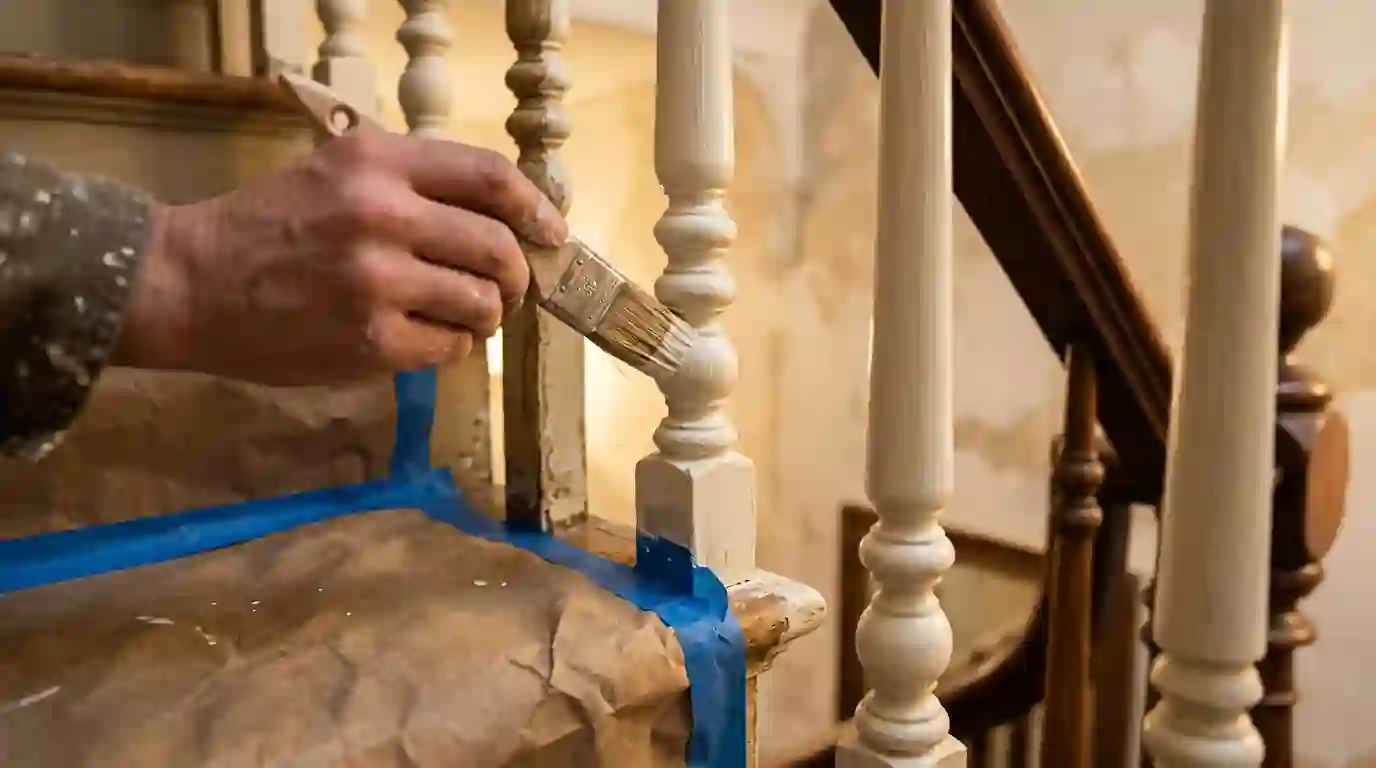
We tape heavy paper on treads and the floor at the bottom, cover the wall along the stair with plastic where the spindles meet it, and set a runner across the landing. Railing brackets on the wall side get masked.
- Coat 02
Test and set controls
On older stairs we test paint for lead before sanding. If it's positive, we set up containment around the stairwell, mist surfaces, and keep a HEPA vacuum running during sanding. Kids and pets stay off the stairs during that work.
- Coat 03
Sand every spindle
We scuff spindles with flexible sanding sponges and abrasive cord that follows turned profiles. The handrail gets a thorough sand to cut through the slick, hand-polished surface. Newel caps and posts get filled where cracked.
- Coat 04
Prime and caulk
A bonding primer goes on handrails, newels and any glossy old enamel. Gaps where risers meet stringers and where spindles meet the rail get a thin bead of caulk so the joints read clean.
- Coat 05
Paint alternating steps
We paint risers and stringers on every other step, or one side of each tread, so a path stays dry. Spindles are painted top to bottom with a small sash brush, with drips caught before they set.
- Coat 06
Finish the rail last
The handrail gets its final coat at the end of a day, when the household can avoid touching it overnight. We tape a small sign at the top and bottom as a reminder, then return to finish the remaining steps.
How much stair painting costs in DC
The number of spindles drives most of the time on a staircase, followed by how much old paint is on them.
| Job | Typical range | What moves the price |
|---|---|---|
| Single flight, spindles, rail and newel | $680 to $1,180 | Spindle count and whether they're square or turned |
| Single flight with risers and stringers too | $940 to $1,620 | Number of steps and amount of caulking at joints |
| Two flights with a landing | $1,480 to $2,450 | Landing balustrade length and staging over the stairwell |
| Tread refinishing in stain and clear coat | $38 to $76 per tread | Sanding through old finish and the number of coats |
| Paint stripping on detailed spindles | $14 to $31 per spindle | Layer depth and whether lead-safe methods apply |
| Lead-safe containment if needed | $380 to $1,450 | Size of the stairwell and how much paint is disturbed |
These are typical ranges, not a quote; we count spindles and set the price after seeing the stair.
Problems a stair repaint takes care of
These are the stair complaints we hear most when we walk into a DC house.
Scuffed white risers
Shoes kick the front of each riser, leaving black streaks that won't wash off flat paint. A durable enamel in satin or semi-gloss resists scuffs and wipes clean.
Sticky or rough handrails
Handrails painted with wall paint or soft finishes feel tacky in humid weather. We use a hard enamel that cures smooth, or keep the rail in natural wood with a clear coat if that suits the house.
Gummy, overpainted spindles
Decades of drips fill in spindle detail. We sand down the bumps and, where buildup is heavy, strip spindles back so turned profiles show again.
Worn painted treads
Painted treads wear through in the center of each step. Floor-rated enamel lasts longer, and some owners switch to stained treads for better wear. Repainting the baseboards along the stair finishes the look.
Stair walls that look dingy
Stair walls get handprints and bag scrapes up their full height. We can paint the wall along the stair in the same visit, which pairs well with interior house painting on the floors above and below.
Products that stand up to hands and feet
Stairs get gripped, kicked and scrubbed. We pick coatings for that.
- Benjamin Moore Advance or Sherwin-Williams Emerald Urethane for spindles, risers and stringers, both cure hard without yellowing.
- Porch and floor enamel for painted treads, since it's made to handle foot traffic.
- A water-based polyurethane for stained handrails or treads, in satin to hide wear.
- Shellac or bonding primer over old oil finishes and slick, hand-worn rails.
- Small Purdy sash brushes and abrasive cord for turned spindles, so profiles stay sharp.
- Paintable siliconized caulk at riser and stringer joints to close gaps that collect dust.
Colors on stairs show wear differently; our sheen and room guide explains how to pick.
Living with the house while the stairs are painted
Stair jobs usually take two to four days. Here's what those days look like.
- You'll always have a path up and down, but it may be along one side of each tread.
- Plan to carry laundry and groceries carefully for a couple of days, since the rail may be wet at times.
- Keep pets away from fresh spindles and treads; we'll tell you each evening which parts are dry.
- Final rail coats are done late in the day so the overnight hours can do the drying.
- If your condo stairwell is a shared space, we confirm the building's work hours first.
Where we do this work most often
We take this job across the District and close-in Maryland and Virginia. These are the neighborhoods and cities we cover most, with a ZIP for each.
Questions we hear about this
Can we still use our stairs while you paint them?
Yes. We paint in halves, alternating steps or one side of each tread, so there's always a dry path. You may need to walk carefully along one side for a couple of days. The handrail gets its final coat at the end of a work day so it can dry overnight. We'll tell you each evening what's safe to touch.
Should DC stair treads be painted or stained?
Stained and clear-coated treads hide wear better and suit many older homes with oak or pine stairs. Painted treads are a good choice when the wood is patched or mismatched, and they look crisp with white risers. Painted treads wear faster in the center, so we use a floor-rated enamel. Some owners split the difference with stained treads and painted risers.
How long does staircase and banister painting take in a rowhouse?
A single straight flight with 40 or so spindles usually takes two to three days, including drying time between coats. Two flights with a landing or a long balustrade can take four to five days. Lead-safe prep and paint stripping add time, which we lay out after the walkthrough.
Can you strip old paint from my turned spindles?
Yes, when the buildup has filled the detail or the old paint is failing. In pre-1978 homes we treat this as lead-safe work, using chemical strippers or low-heat methods inside containment. It's slow, careful work, so we price it per spindle. If you'd rather keep cost down, sanding and repainting often gets a good result without stripping.
Will a painted handrail feel sticky in DC summer humidity?
Not if it's done with the right product and allowed to cure. Stickiness usually comes from soft wall paint or from handling the rail before it's cured. We use a hard enamel and ask that the rail be used gently for the first week. After about three weeks it reaches full hardness and feels smooth even on muggy days.