Short answer
Drywall repair in DC covers cutting out damaged board, fitting new pieces on backing, taping and building three thin coats of joint compound, sanding, matching texture and spot priming. Water-damaged areas are checked for moisture first. A small patch typically runs $165 to $340, and larger sections or ceiling repairs climb from there depending on size and finish level.
How we take a damaged wall back to smooth
Joint compound needs drying time between coats, so most patches span two short visits or one long day with fast-setting mud.
- Coat 01
Find the cause first
For stains and soft spots we check with a moisture meter before cutting anything. A patch over drywall that's still wet will stain and crumble again, so a leak must be fixed and dried out first.
- Coat 02
Cut back to solid board
We square up the damaged area with a drywall saw, cutting back to sound gypsum and to the nearest stud where possible. Crumbling or moldy board comes out, not just the visible stain.
- Coat 03
Add backing and fit the new piece
Furring strips or the existing studs give the patch something to screw into. A matching thickness of board, usually half inch on walls and five-eighths on some ceilings, is screwed in place.
- Coat 04
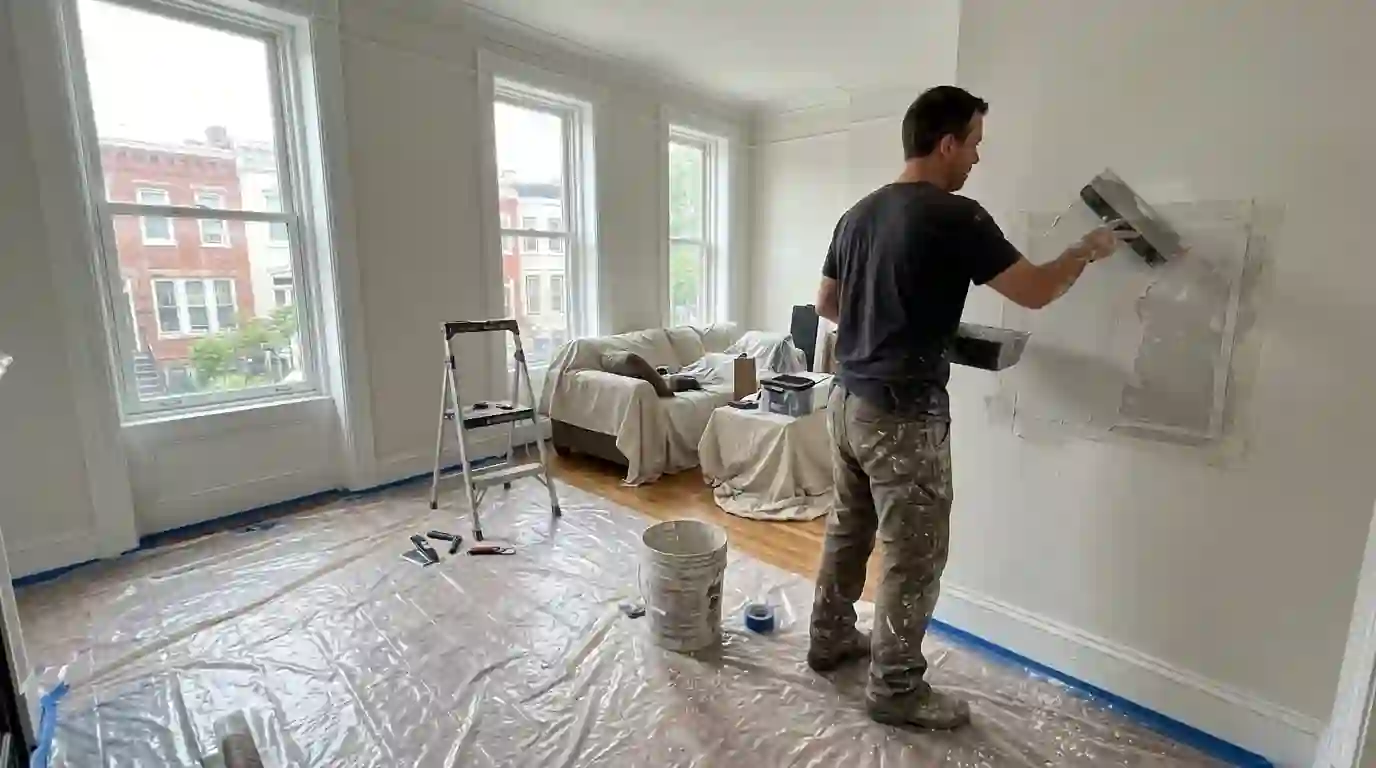
Tape and set the first coat
Paper tape goes on the seams, bedded in a setting-type compound that hardens chemically in 20 to 90 minutes. That lets us move to the next coat sooner and keeps shrinkage down.
- Coat 05
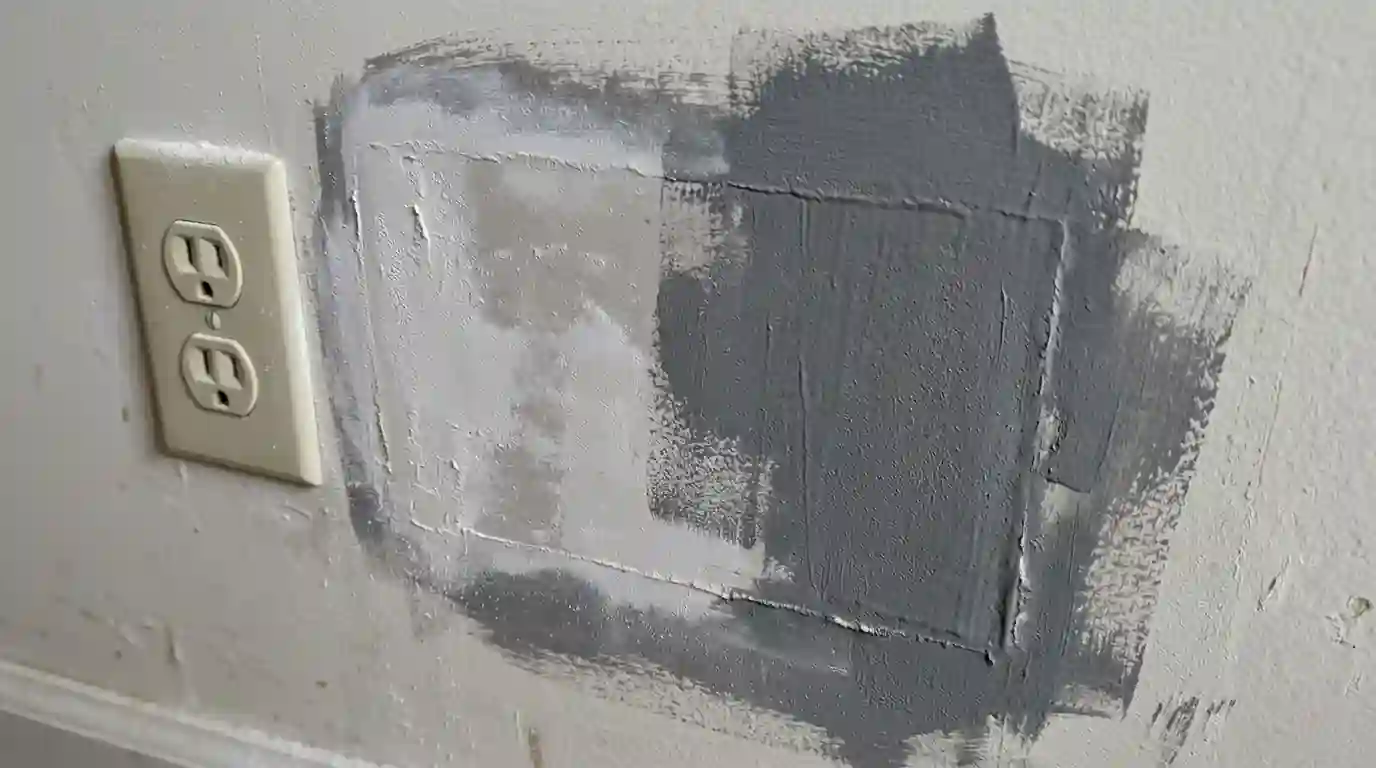
Feather two more coats
Two wider coats of lighter topping compound are troweled on, each feathered several inches past the last. Thin coats shrink less and sand easier than one heavy layer.
- Coat 06
Sand, texture and prime
We sand with a vacuum-connected sander to keep dust down, then spray or hand-match orange peel, knockdown or skip-trowel texture. A primer seals the compound so paint doesn't flash over the patch.
Damage we fix most often in DC homes
Drywall is mostly found in renovated rowhouses, condo buildings, basements and newer additions around the city.
Doorknob and furniture holes
A missing door stop or a moving dolly can punch a fist-size hole in seconds. These get a cut-in patch with backing, not a mesh sticker that shows through paint later.
Nail and screw pops
Fasteners push out as framing dries and shrinks, especially in newer condo buildings. We reset them with a screw beside each pop, then fill and spot prime.
Cracked seams over doors
Diagonal cracks off door and window corners come from framing movement. We cut a V, re-tape with paper tape and feather so the crack is less likely to return.
Water stains and sagging ceilings
A bathroom leak above or a failed roof flashing leaves brown rings and soft board. After the source is fixed, we replace the soft section and stain-block the edges.
Peeled paper after tape removal
Pulling tape or old wallpaper can tear the drywall's face paper. Torn paper gets sealed with a shellac-based or oil primer before skim coating, or it bubbles.
Old wall anchor holes
TV mounts, shelving and curtain rods leave clusters of large anchor holes. Patching them together saves time and leaves a cleaner wall than spot filling each one.
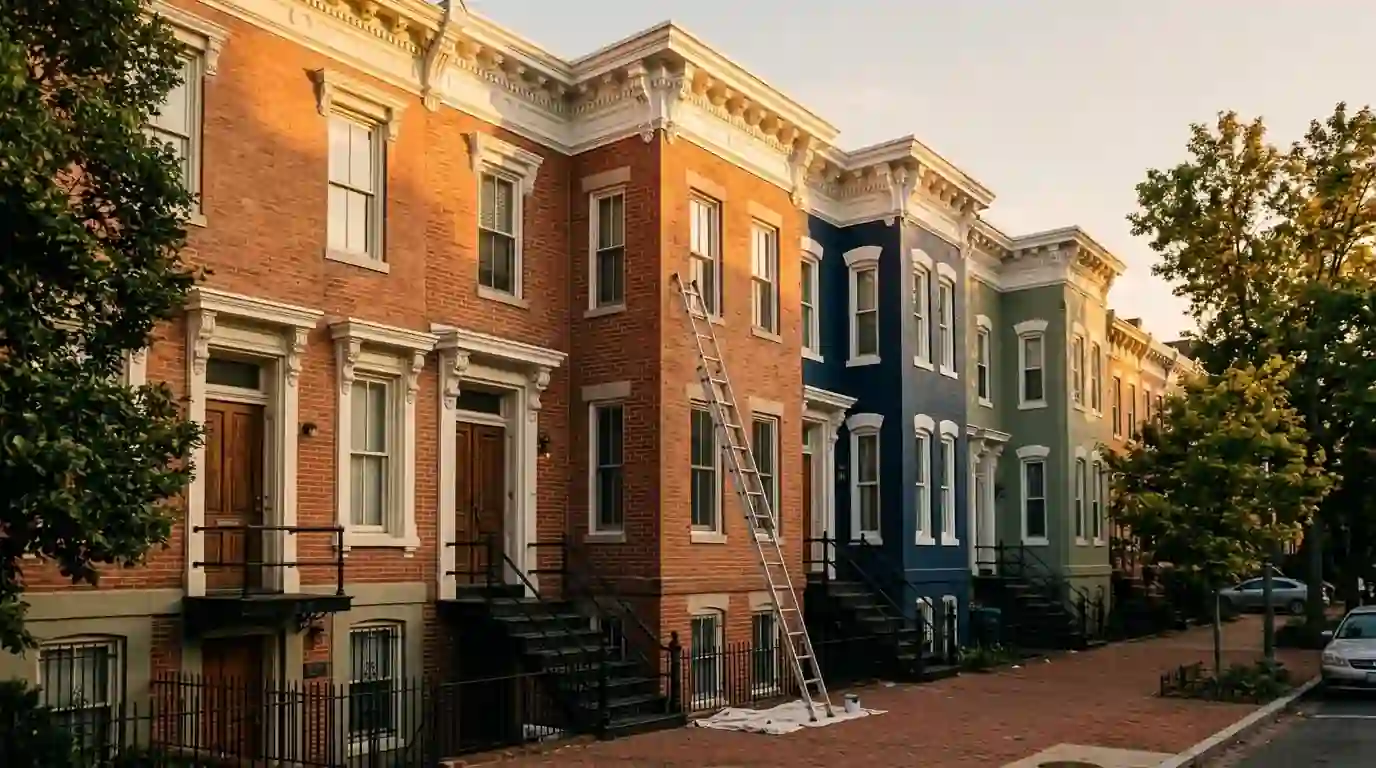
Drywall in a city built on plaster
Many DC houses built before 1950 still have plaster walls, but very few have only plaster. Kitchens, baths and basements were often gutted and redone in drywall, so a single Brookland rowhouse can have horsehair plaster in the front rooms and half inch board in the rear addition. We look at what each wall actually is before patching, because the methods differ. Where you have true plaster, our plaster repair approach is the right one.
Where drywall meets old plaster, the two materials move differently. The joint between them cracks year after year unless it is reinforced with paper or fiberglass tape bedded in setting compound. We also pay attention to depth: plaster walls are often thicker than modern board, so a drywall patch may need shimming to sit flush.
Humidity plays a part too. In muggy August weeks, joint compound takes far longer to dry, and fans or a dehumidifier make a real difference. In English basements, where moisture is a constant guest, we suggest mold-resistant board for any section near the floor or an exterior wall.
What a patching visit looks like in your home
Drywall work is short but dusty, so a little planning keeps the rest of the house clean.
- Clear about four feet in front of each damaged wall, or tell us and we'll move furniture.
- We cover floors and nearby furniture, and hang plastic over doorways when sanding.
- Fast-setting compound lets many small patches be primed the same day.
- Bigger repairs need a second short visit after the compound has dried overnight.
- In a condo, most buildings ask for set work hours, which we schedule around.
- Paint touch-ups or full-wall repainting happen once primer has dried.
What drywall patching typically costs here
Size, height and how invisible the repair needs to be drive the cost more than anything else.
| Job | Typical range | What moves the price |
|---|---|---|
| Small patch, up to about 6 inches | $165 to $340 | Texture matching, number of holes in the room |
| Medium cut-in patch, up to 2 feet | $285 to $560 | Backing needed, corner bead, wall height |
| Water-damaged ceiling section | $420 to $1,180 | Area replaced, stain-blocking, ceiling height |
| Re-taping cracked seams, per room | $310 to $740 | Number of cracks, corners, ceiling vs wall |
| Skim coating a damaged wall | $460 to $1,090 | Wall size, torn paper, Level 5 finish |
| Repaint after patching, one room | $485 to $860 | Color change, ceiling included, trim |
These are typical DC ranges, not a quote; we confirm the price once we've seen the damage.
Compounds and tools that make a patch disappear
The products matter, but so does using each one where it belongs.
- Setting-type compound for the first coat, because it hardens fast and resists cracking at seams.
- Lightweight topping compound for the final coats, since it sands easily and leaves a smooth face.
- Paper tape on flat seams and corners, which holds better than mesh in moving joints.
- Mold-resistant board for bathrooms and basement walls near the slab.
- A dust-extracting sander, for example a Festool, connected to a HEPA vacuum to keep dust out of the rest of the house.
- A drywall primer such as Zinsser Gardz over torn paper or freshly mudded patches before paint.
- Spray texture or a hopper for knockdown and orange peel matching on larger areas.
If several rooms need work, it often makes sense to bundle patching with interior house painting so every wall is finished at once.
Where we do this work most often
We take this job across the District and close-in Maryland and Virginia. These are the neighborhoods and cities we cover most, with a ZIP for each.
Questions we hear about this
Can you match the texture on my DC condo's walls after a drywall patch?
Most DC condo buildings use light orange peel or a smooth finish, and both can be matched closely. We test the texture on a scrap board first, then spray or roll it onto the patch. Under the right paint sheen, the repair is very hard to find. Heavy knockdown or hand-troweled textures take more time but are still matchable.
Should I repaint the whole wall after a drywall repair?
Usually, yes. Even when we use leftover paint from your last job, a touched-up patch tends to show as a slightly different sheen in raking light. Painting the full wall, corner to corner, gives an even finish. For condos and rentals, we often paint the whole room since the cost difference is small.
How quickly can you fix a hole in drywall in Washington, DC?
We answer calls 24/7 at (771) 247-4038 and can usually see a small repair within a few days. Fast-setting compound lets us finish many holes in one visit, ready for paint the same afternoon. Larger water-damaged ceilings take two or three visits so each coat dries properly in DC humidity.
Do you fix drywall cracks that keep coming back every winter?
Recurring cracks mean the joint moves seasonally, so filling them with spackle won't last. We cut the crack open, bed fresh paper tape in setting compound and feather it wide. In bad cases we add a flexible crack bridging tape. Persistent diagonal cracks may point to framing issues worth checking with a contractor.
Can drywall repair be done when I'm getting a rental ready?
Yes, and it is one of the most common reasons we patch walls. Between tenants we fill anchor holes, fix door-stop damage and re-tape cracks, then paint. Our rental turnover painting service bundles patching and paint on a tight schedule, and we work in Brightwood and across the city.