Short answer
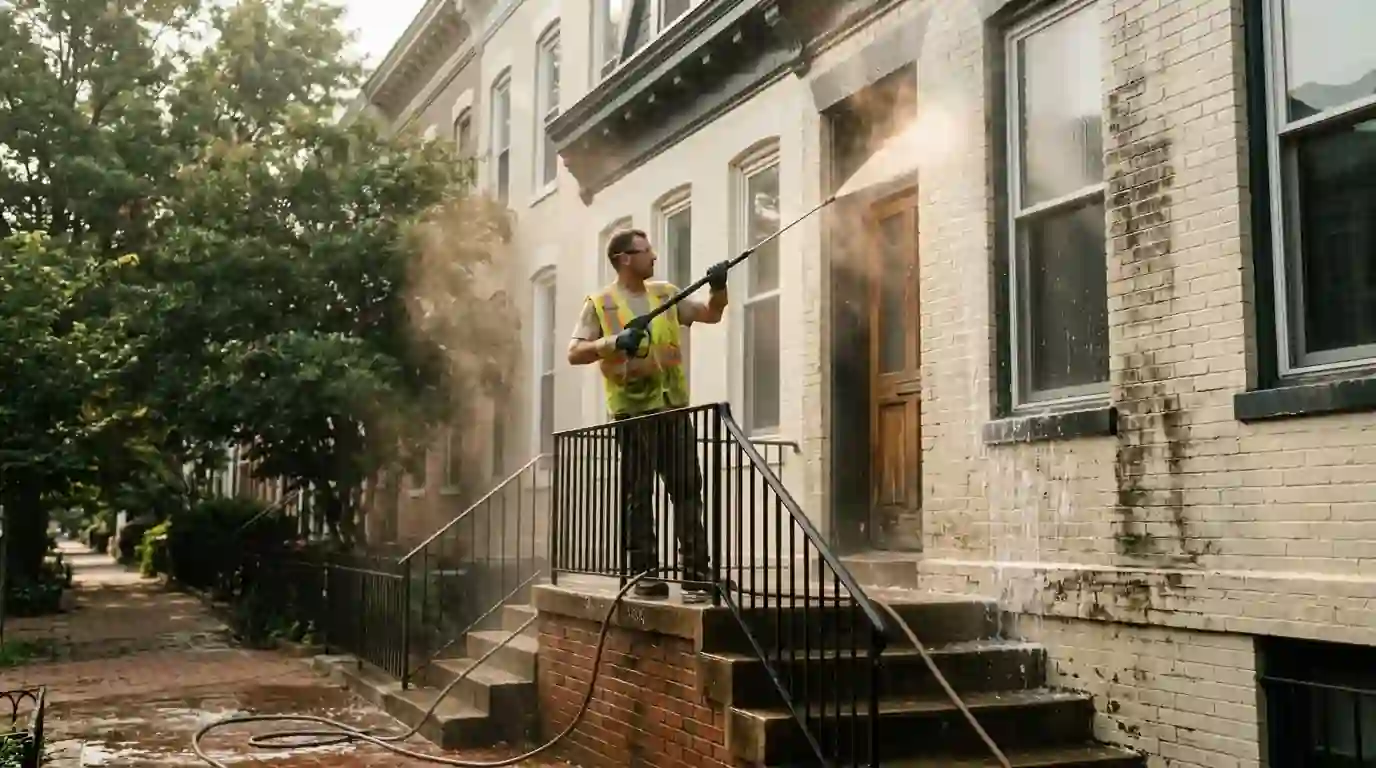
Pressure washing for paint prep in DC means killing mildew with a cleaner, rinsing siding, brick, porches and decks at a controlled pressure (often 500 to 1,500 PSI with a wide fan tip), scraping what lifts, and waiting a day or two of dry weather before priming. A full house wash typically runs $285 to $640, with decks and porches priced on their own.
Is your house telling you it needs a wash first?
Most of these show up on the shaded side of the house before anywhere else, so walk the north wall and the back alley side when you check.
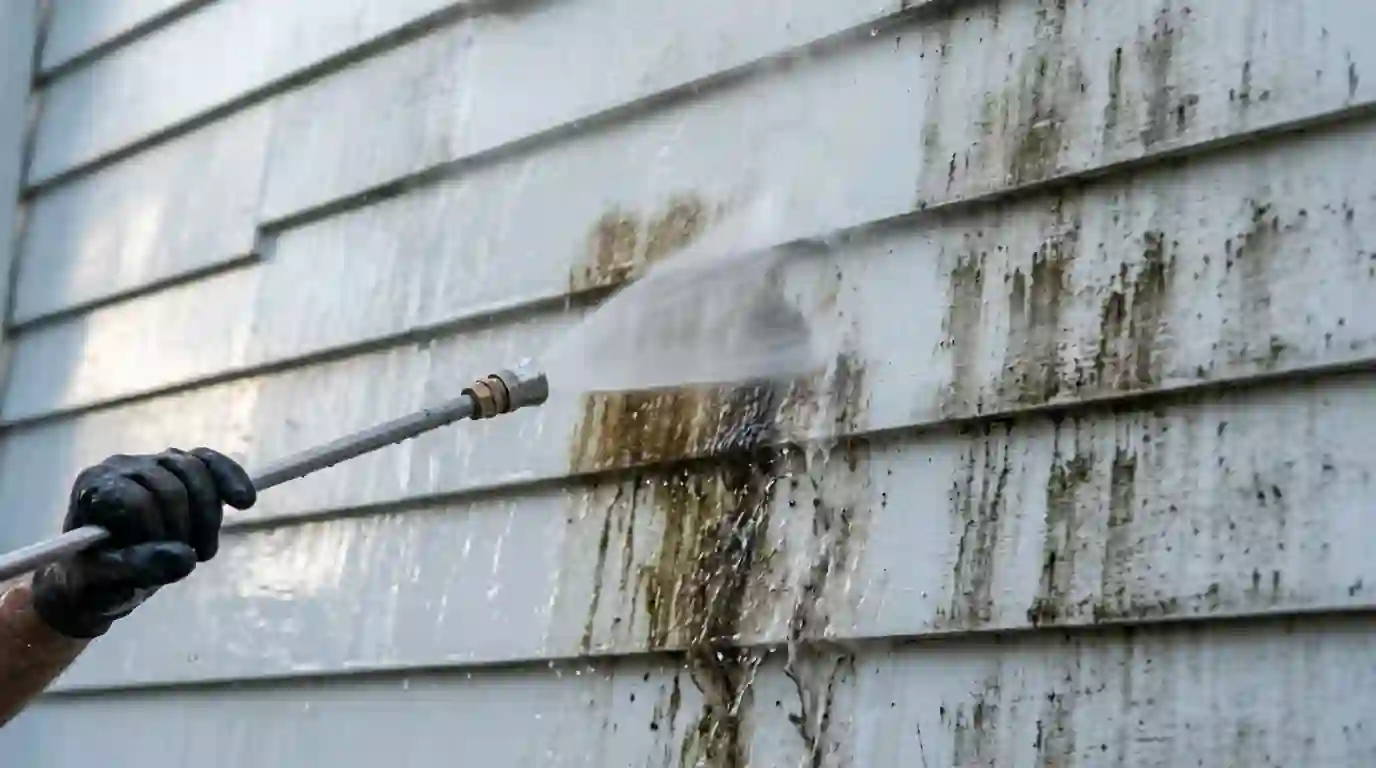
Black or green streaks
Mildew colonies feed on the film that settles on paint. If a damp rag turns dark and the streak lightens, it's organic growth, and painting over it only traps food for the next bloom.
Chalk on your fingertips
Rub the siding and look at your hand. White or colored powder means the old binder has broken down, and new paint laid on chalk can peel in sheets within a couple of seasons.
Soot film on a city facade
Rowhouse fronts on busy streets collect a gray film from traffic and buses. It looks like dull paint, but it's a loose layer that keeps primer from biting into the surface.
White crust on brick
Efflorescence is salt pushed out of masonry by moisture. It has to be washed and brushed off, and the water source checked, before any masonry coating will hold.
Gray, fuzzy deck boards
Sun-broken wood fibers stand up on old decks and fences. Washing at low pressure, plus a brightener, takes that dead layer off so stain soaks into sound wood.
What makes washing a DC house different from a suburban driveway job
Humidity is the big one. Washington summers keep shaded walls damp for days, so mildew returns quickly on north faces, under porch roofs and along narrow side yards between rowhouses. That's why we kill growth with a cleaner first and rinse second, instead of trying to blast it off with pressure alone. Pressure removes what you can see; the cleaner removes what grows back.
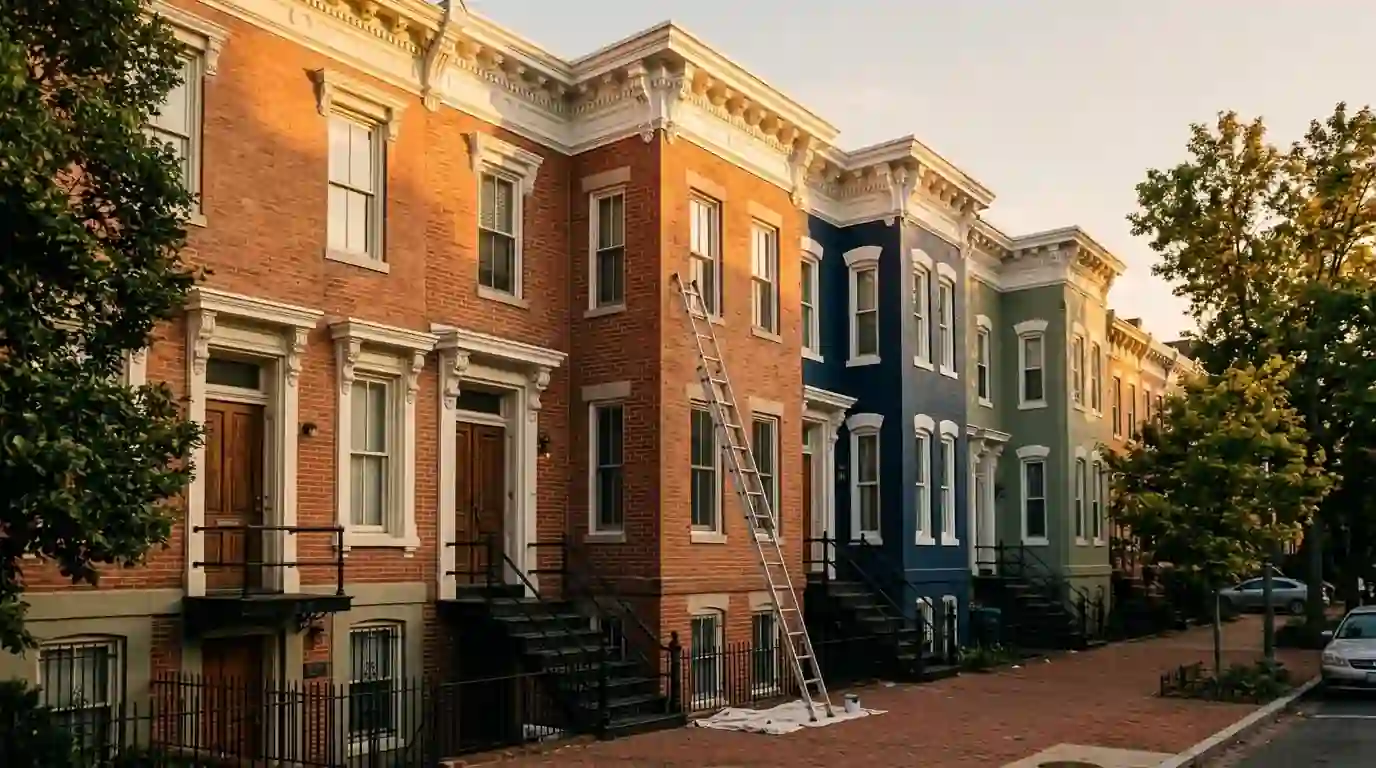
Rowhouse blocks add their own limits. Your neighbor's windows, cars and front garden sit a few feet away, and the party wall means our spray stops at a shared line. We tape off vents, cover plants and keep the fan angle low near property edges. On a Capitol Hill rowhouse we often work the front from the sidewalk and the back from the alley, with hoses run through the house only when there's no other spigot.
Old brick is the other trap. Much of the city's pre-1900 masonry is laid in soft lime mortar, and high pressure can scour joints and the fired face of the brick. On those walls we stay under about 500 PSI and lean on brushes and cleaner. If the wash shows open joints, we flag them before any brick and masonry painting is priced, because paint will not hold where mortar is washing out.
How we wash a house from the roof line down to the sidewalk
A paint-prep wash takes most of a day on a detached house and a morning on a rowhouse front. Here is the order we follow.
- Coat 01
Test spot and pressure check
We pick a hidden patch on each surface (siding, trim, brick, deck) and test the tip and pressure there. Soft cedar, old pine trim and lime-set brick each get their own setting, written down before the full wash starts.
- Coat 02
Cover what should stay dry
Outlets, light fixtures, dryer vents and door thresholds get plastic and tape. Plants are wetted first and covered with breathable drop cloths, and neighbor cars or windows within reach of overspray are shielded or moved.
- Coat 03
Apply the cleaner low and slow
A diluted sodium hypochlorite or oxygen-based cleaner goes on at low pressure from the bottom up, so it doesn't streak. It dwells eight to twelve minutes, never long enough to dry on the surface in summer sun.
- Coat 04
Rinse top down with a fan tip
We rinse from the gutter line toward the ground with a 25 or 40 degree tip, keeping the wand about a foot or more away. Water should never be driven upward into lap joints or under window flashing.
- Coat 05
Scrape and mark what the wash revealed
Once the surface is clean we scrape loose paint, mark soft wood with tape and note failed caulk. That list becomes the repair scope, and nothing is hidden under a fresh coat.
- Coat 06
Dry time and moisture reading
Wood should read under about 15 percent on a moisture meter before primer. In DC that usually means 24 to 48 hours of dry weather, longer on shaded walls or after an afternoon storm rolls through.
Typical costs for washing and prep around DC
Most washes are booked as the first day of a paint job, but we also wash on their own. These are the ranges we see most often in the city and close-in suburbs.
| Surface or job | Typical range | What moves the price |
|---|---|---|
| Detached house, full exterior wash | $285 to $640 | Height, number of stories, mildew load, and whether second-floor areas need ladders or an extension wand |
| Rowhouse front facade only | $195 to $415 | Brick versus painted brick, cornice height, sidewalk traffic and how much masking the stoop and railings need |
| Deck wash with brightener | $0.45 to $0.95 per sq ft | Old stain residue, gray fiber depth, stairs and railings, and whether a stripper is needed first |
| Porch floor, ceiling and columns | $145 to $310 | Size, peeling paint that must be contained, and whether the porch ceiling has mildew spotting |
| Wood fence, both faces | $0.85 to $1.70 per linear ft | Fence height, access to the neighbor's side, and plantings growing into the boards |
| Wash added to a paint job we're doing | $165 to $390 | Less than a standalone visit because our painters are already set up, ladders and all |
These are typical ranges for planning, not a quote; we set the actual price after a walkthrough of your house.
When a soft wash is the safer choice than pressure
Not every surface should see a high-pressure stream. Painted siding on houses built before 1978 often has lead in the lower layers, and blasting it sends chips and dust into soil and across the property line. On those homes we wash at low pressure, wet scrape by hand and collect debris on ground sheeting, following EPA RRP lead-safe work practices. Our lead-safe painting page explains what that containment looks like, and this guide on lead paint in pre-1978 homes covers the testing side.
Soft washing also suits cedar shakes, old window sashes with loose glazing, stucco with hairline cracks and anything that holds water behind it. The cleaner does the work, the rinse is gentle, and we follow with brushes where grime is stubborn. It takes a little longer, but it doesn't open new paths for water to get behind the paint you're about to buy.
Cleaners and gear we match to each surface
We keep the kit simple and change it by material, not by habit.
- A gas pressure washer around 3,000 PSI at the pump, throttled down at the wand with tips from 25 to 40 degrees, so the machine is never running at full force on a house.
- Diluted sodium hypochlorite with a surfactant for mildew on siding and trim, mixed weak and rinsed well so it doesn't burn plantings.
- Sodium percarbonate (oxygen bleach) for decks and fences, followed by an oxalic acid brightener like the one Cabot sells, which restores the wood's color before stain.
- Soft-bristle brushes on Wooster extension poles for lime-set brick and cornices, where scrubbing beats pressure every time.
- A pin-type moisture meter, which decides when painting can start far better than a guess based on how the wall looks.
How you can help on wash day
A few small things before we arrive keep the day short and the water where it should be.
- Close every window and storm window, including basement and English basement windows that sit close to the ground.
- Move grills, patio furniture, planters and bikes at least six feet from the walls being washed.
- Park your car away from the house, and let us know if we should request DDOT emergency no-parking signs for our truck on a tight block.
- Show us your outdoor spigots and confirm the water is on, since some DC houses have the hose bib shut off inside for winter.
Where we do this work most often
We take this job across the District and close-in Maryland and Virginia. These are the neighborhoods and cities we cover most, with a ZIP for each.
Questions we hear about this
Can pressure washing damage the brick on my DC rowhouse?
It can if the pressure is too high. A lot of DC brick from before 1900 sits in soft lime mortar, and a narrow tip will cut into joints and strip the fired face of the brick. We test first, stay low, use cleaner and brushes for the heavy lifting, and stop to show you any mortar that's already failing.
How long does a house need to dry after washing before painting starts?
Usually 24 to 48 hours of dry weather, but we go by a moisture meter rather than the calendar. Shaded walls, north faces and porch ceilings can take longer, and an afternoon thunderstorm resets the count. Painting wet wood is one of the fastest ways to get blisters by the next summer.
Do you pressure wash a house that has lead paint?
We don't blast it. On homes built before 1978 we assume lead is present unless a test says otherwise, so we wash at low pressure, lay ground sheeting, wet scrape and clean up under EPA RRP lead-safe practices. That keeps chips out of your soil and off the neighbor's side of the fence.
Is a wash on its own worth booking if I'm not repainting this year?
Often, yes. Removing mildew and soot every year or two slows how fast paint chalks and lets you spot small failures, like split caulk or a soft sill, while they're cheap to fix. Pair it with caulking and weatherproofing and you can stretch a paint job a few more seasons. Call (771) 247-4038 to set a date.
Where does the runoff go when you wash a rowhouse front?
We keep cleaner diluted and rinse plantings before and after. Water from the facade runs to the gutter line at the curb, and we sweep paint chips and debris off the sidewalk instead of hosing them toward the storm drain. On lead jobs, debris is bagged with the rest of the containment waste.